
dateModified: 2026-10-28
Quick Answer: For 2026, shipping from China to Germany means paying German import VAT of 19% on the customs value (goods + duty + freight), holding an EORI number if you import as a business, and complying with the VerpackG packaging law for business-to-consumer parcels. From 1 July 2026 the long-standing €150 duty-free threshold is abolished (Council Regulation (EU) 2026/382), so most consumer goods are now dutiable; a temporary flat duty of about €3 per product category applies through 1 July 2028, with a roughly €2 per-consignment handling fee introduced from November 2026. Alicarrier acts as your China buying team: our Europe desk covers door-to-door DDP into Germany, France, Spain, Italy, the Netherlands and Poland, with import VAT and IOSS prepaid and duty classified by HS code. Transit runs 6–10 days air DDP or 28+ days sea FCL; courier express (per carrier) is faster. Quotes are returned in 3–5 business days. Rates are planning ranges only and must be confirmed by quote.
Germany is the largest e-commerce and B2B import market in the EU, and for overseas buyers sourcing from Taobao, Tmall, 1688 or Alibaba.com it is also one of the most rule-heavy. This guide distils the 2026 regime into what actually affects your landed cost and your customs risk, then shows how a DDP agent removes the friction. All figures below are planning ranges or publicly known 2026 rates; they are not live quotes and must be verified with official sources before you ship.
Germany’s market scale means even small miscalculations in VAT or packaging compliance can erode margin quickly. Importers should treat the 2026 changes as a structural shift rather than a temporary adjustment: the removal of the low-value duty exemption, paired with the new handling fee, makes accurate pre-shipment costing essential. Alicarrier’s role is to absorb that complexity—classifying goods, paying the correct duty and VAT under DDP, and delivering to your German address without you engaging with Zoll directly. For small retailers and individual buyers alike, the practical question is rarely “can I import?” but “who handles the paperwork so I don’t pay twice or wait weeks at the border?”
The 2026 EU Import Regime (Applies to Germany)
Germany applies the common EU customs union rules. The 2026 changes that most affect China-origin parcels and containers:
- €150 duty-free threshold abolished from 1 July 2026 (Council Regulation (EU) 2026/382). Low-value goods are no longer automatically duty-free at the border.
- Temporary flat duty of ~€3 per product category applies as a transitional measure until 1 July 2028, while the new EU customs framework is phased in.
- Handling fee of ~€2 per consignment for customs processing, introduced from November 2026.
- IOSS (Import One-Stop Shop) remains optional. Under DDP, the seller/agent accounts for VAT at import, so IOSS is not required for the buyer.
- EORI number is mandatory for business importers to clear goods into the EU (including Germany).
- Product Identification Data (PIDs) requirements take effect from 1 November 2026 to improve traceability of imported goods.
Note: regulations evolve. Always verify thresholds, duty rates and fees with the German customs authority (Zoll) and the EU Official Journal before committing a shipment.
What the New Rules Mean in Practice
The table below contrasts the pre-2026 low-value flow with the 2026 reality for a typical China-to-Germany B2C or small-B2B parcel.
| Step | Before 2026 (≤€150) | From 2026 |
|---|---|---|
| Duty on low-value goods | €0 (de-minimis) | ~€3 flat per category (transition to July 2028), then standard HS duty |
| VAT (19% German) | Due on consignment >€150 only | Due on virtually all imports; collected at border |
| Handling fee | Not applied | ~€2 per consignment from Nov 2026 |
| Buyer paperwork | Minimal | EORI (business) + accurate HS/data; higher risk of hold if missing |
| Best Incoterm | DAP acceptable | DDP strongly preferred to avoid door-step VAT surprises |
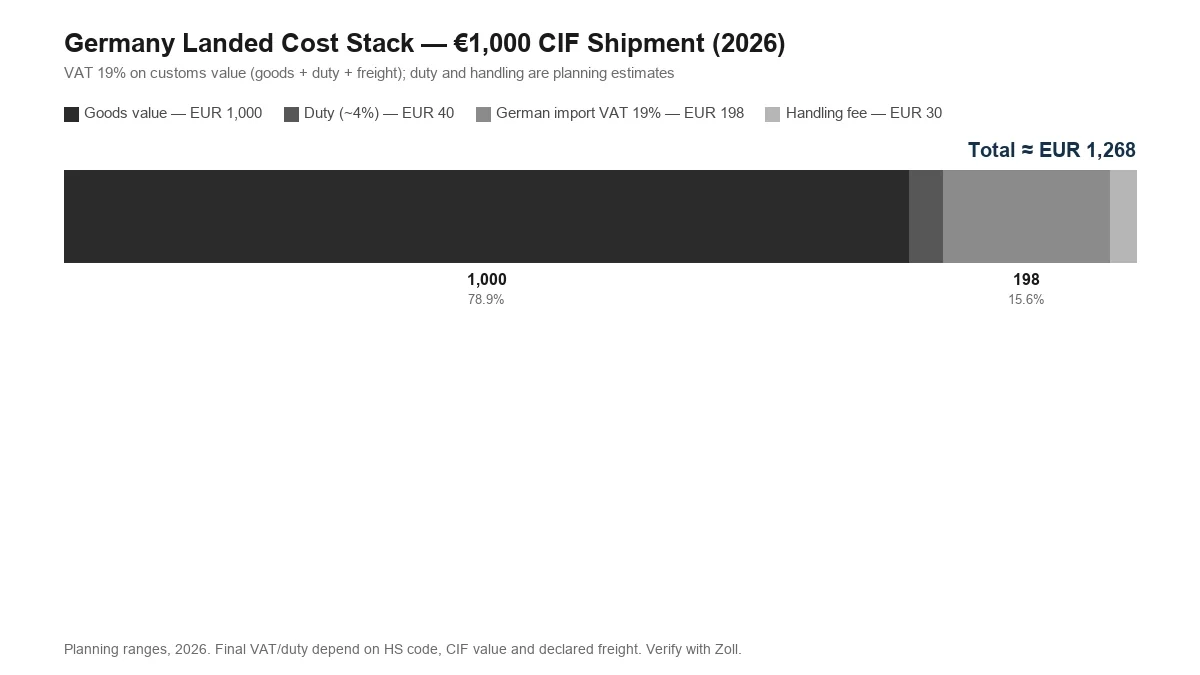
Germany Landed-Cost Stack (Illustrative)
The chart shows how a €1,000 goods value breaks down after German import charges under a representative DDP plan. VAT is 19% of (goods + duty + freight); duty and handling are planning estimates.
Shipping Methods: China to Germany
Four mainstream routes serve Germany, delivered door-to-door under Alicarrier’s DDP Global Shipping service with DHL, FedEx, UPS or DPD on the final mile. Planning ranges below are per-kg or per-volume and exclude duties/VAT already shown above.
Express Courier DDP (DHL / FedEx / UPS via agent)
| Attribute | Planning Range |
|---|---|
| Weight / volume | Parcels up to ~100 kg |
| Rate (planning) | ~US$8–15 per kg |
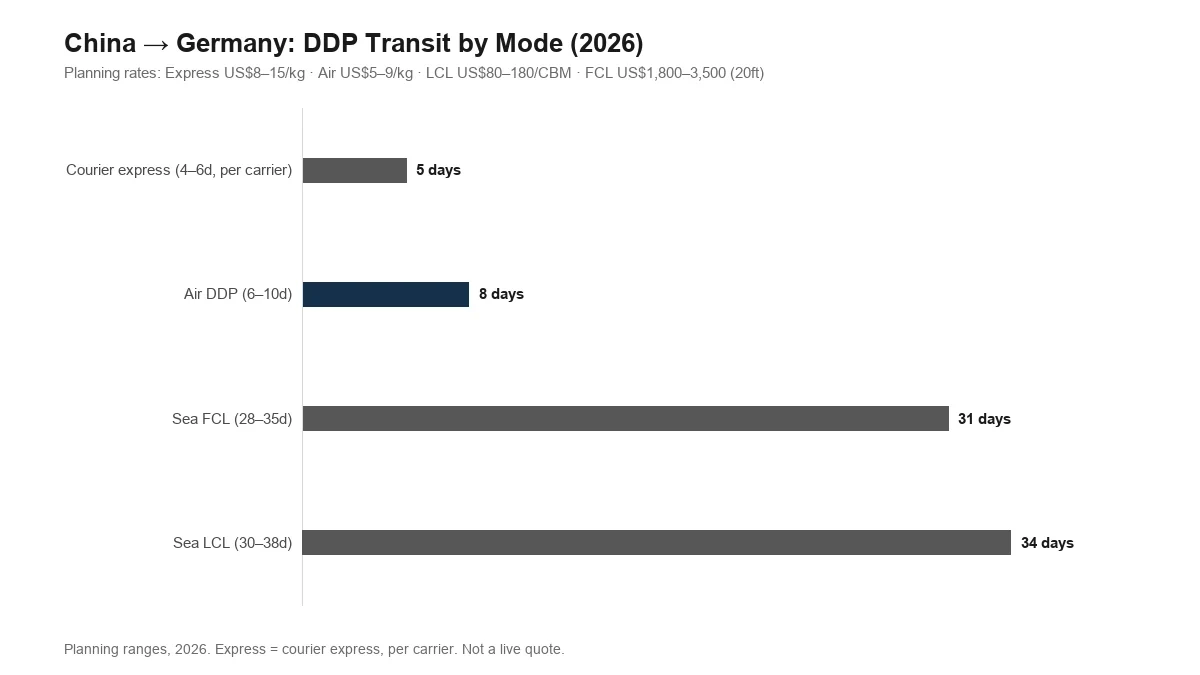
| Transit | ~4–6 days (courier express, per carrier) |
| Best for | Samples, urgent B2C, low-volume |
Air Freight DDP
| Attribute | Planning Range |
|---|---|
| Weight / volume | 100 kg – 1,000 kg |
| Rate (planning) | ~US$5–9 per kg (+ fuel surcharge) |
| Transit | 6–10 days |
| Best for | Replenishment, time-sensitive stock |
Sea LCL DDP (Less than Container Load)
| Attribute | Planning Range |
|---|---|
| Weight / volume | From 1 CBM / ~200 kg |
| Rate (planning) | ~US$80–180 per CBM |
| Transit | 30–38 days to Hamburg |
| Best for | Furniture, bulk goods, cost focus |
Sea FCL DDP (Full Container Load)
| Attribute | Planning Range |
|---|---|
| Weight / volume | 20ft / 40ft container |
| Rate (planning) | ~US$1,800–3,500 (20ft); ~US$2,800–5,000 (40ft) |
| Transit | 28–35 days (28+ days per Alicarrier Europe desk) |
| Best for | Full containers, Amazon FBA DE |
Before anything ships, goods from multiple suppliers arrive at our Guangzhou warehouse under the Receive, Inspect & Consolidate service: every carton is counted, photographed and quality-checked, then merged into one shipment. You get 30 days free storage, then tiered daily rates, which makes it easy to wait for slow suppliers before booking air or sea space. Under Sourcing & Purchasing, our team can also buy on your behalf from Taobao, Tmall or 1688 at an 8% flat fee (minimum US$50 per order), negotiating MOQs and verifying suppliers first.
Shipping Mode Comparison (Transit by Mode)
Germany VAT & Duty Data
| Item | Germany 2026 |
|---|---|
| Standard VAT (Umsatzsteuer) | 19% |
| Reduced VAT (food/books) | 7% |
| Import duty | EU Common External Tariff by HS; many electronics 0%, textiles higher |
| EORI | Required for business importers |
| VerpackG (LUCID) | Business shippers must register & pay packaging licence |
| Amazon FBA DE | DDP to DE fulfilment centre recommended |
Customs Documents Required
- Commercial Invoice — seller, buyer, HS code, value, origin.
- Packing List — carton count, dimensions, weights.
- EORI number — for business clearance into the EU.
- HS code — drives duty rate and PID data from Nov 2026.
- EUR.1 / preference docs — generally not applicable for China origin (no FTA), but keep origin evidence.
- VerpackG / LUCID registration — for business-to-consumer packaging placed on the German market.
Regional & Category Notes
VerpackG (Packaging Act)
Any business sending packaged goods to German consumers must register with the LUCID database and contract a dual system for recycling. As the DDP importer of record, Alicarrier can advise on compliant packaging for your German deliveries.
Amazon FBA Germany
For FBA DE, ship DDP to the assigned fulfilment centre. Provide accurate HS and PID data to avoid inbound holds. Sea FCL is the cost-efficient choice for palletised reorders.
Reduced-rate goods
Books and certain foods qualify for 7% VAT, not 19%. Confirm the HS classification before quoting, as it changes the VAT line materially.
For first-time importers, the most common failure is underestimating the VerpackG obligation: even a single consumer parcel with commercial packaging can trigger a LUCID registration duty, and non-compliance can block future deliveries. Planning the shipment as DDP from the outset avoids these surprises and keeps your focus on selling rather than filing. Equally, buyers who consolidate several Taobao or 1688 orders into one German entry typically save more on the per-consignment handling fee than they lose in transit time—an important trade-off when volumes are still small.
Germany / EU DDP Checklist
- Confirm goods value and HS code before shipping.
- Business importer? Obtain an EORI number.
- Register VerpackG / LUCID if selling B2C in Germany.
- Choose DDP so VAT and duty are paid at origin/import, not at your door.
- Consolidate multiple Taobao/1688 orders to cut per-parcel handling fees.
- Keep commercial invoice and packing list accurate for PID compliance (from Nov 2026).
Or contact us on WhatsApp: +86 186 2081 3538 — quotes are returned in 3–5 business days. Prefer to model costs first? Try the Cost Calculator or the Ship to Europe page.
Quick Tips:
Quick Tips
Alicarrier is a China-based buying and shipping agent — your buying team in China — covering three services: Sourcing & Purchasing (we buy from Taobao, Tmall and 1688 at an 8% flat fee, minimum US$50, with supplier verification and MOQ negotiation), Receive, Inspect & Consolidate (Guangzhou warehouse receiving, QC photos, repacking; 30 days free storage, then tiered daily rates), and DDP Global Shipping (all-in door-to-door quotes with DHL, FedEx, UPS, DPD or Aramex final mile). The standard flow follows seven steps: send link → verify & quote → we purchase → inspection & consolidation → choose shipping method → international transport → customs clearance & delivery. No Chinese language skills, no Chinese bank account, and no customs paperwork required on your end.
Frequently Asked Questions
Do I need an EORI number to import from China to Germany?
If you import as a business, yes—an EORI number is mandatory for EU customs clearance. If you buy as a private consumer through a DDP agent like Alicarrier, the agent handles import formalities and you do not need to register.
How long does DDP shipping from China to Germany take in 2026?
Planning ranges: air DDP 6–10 days and sea FCL 28+ days (28–35 days) on the Alicarrier Europe desk; sea LCL runs 30–38 days; courier express (DHL/FedEx/UPS, per carrier) can deliver in roughly 4–6 days. Confirm current schedules when you request your quote.
Is the €150 duty-free threshold still available in 2026?
No. It was abolished from 1 July 2026 under Council Regulation (EU) 2026/382. Low-value goods now attract a temporary ~€3 flat duty per product category until 1 July 2028, plus a ~€2 per-consignment handling fee from November 2026. Always confirm with Zoll before shipping.
What does Alicarrier charge for sourcing and storage?
Sourcing & Purchasing carries an 8% flat fee on goods value (minimum US$50 per order). Consolidated goods enjoy 30 days free storage at the Guangzhou warehouse, then tiered daily rates. Shipping is quoted all-in under DDP; expect your quote in 3–5 business days.
All rates and landed-cost figures in this article are planning ranges and illustrative examples only, not live quotations. Regulatory details (€150 threshold abolition, €3 flat duty, €2 handling fee, PIDs) reflect 2026-known measures cited as Council Regulation (EU) 2026/382; verify all thresholds, duty rates and fees with Zoll and the EU Official Journal before shipping.
Related guides: