
We ship DDP, door to door. Duty, import VAT and customs clearance are settled before dispatch — nothing is payable when your parcel arrives. We act as importer of record. DDP everything within the compliance boundary. Fast and verified: quote in 2 hours, air DDP 6–12 days, sea transit from 30 days; cut-offs verify at booking. One itemised USD line: product value, 6%→2% tiered fee, China inland freight, all-in DDP freight. For CNY 2027 (02-06, eve 02-05), work back from the 2–4 week wind-down.
What “stable and professional” means when customs, not the catalogue, is the constraint
Most December enquiries arrive as a list of goods: phone cases, LED desk lamps, branded scarves, a carton of lithium power banks, stoneware kitchenware. The question behind this guide is different. A small buyer in Lyon, sourcing battery-powered desk lamps and branded accessories from 1688 and Tmall, does not ask whether the category is allowed. She asks what happens if a customs officer examines the carton in the first week of February and wants a spec sheet. Who answers that letter? Who pays while the carton sits? That is a question about responsibility, not about the catalogue.
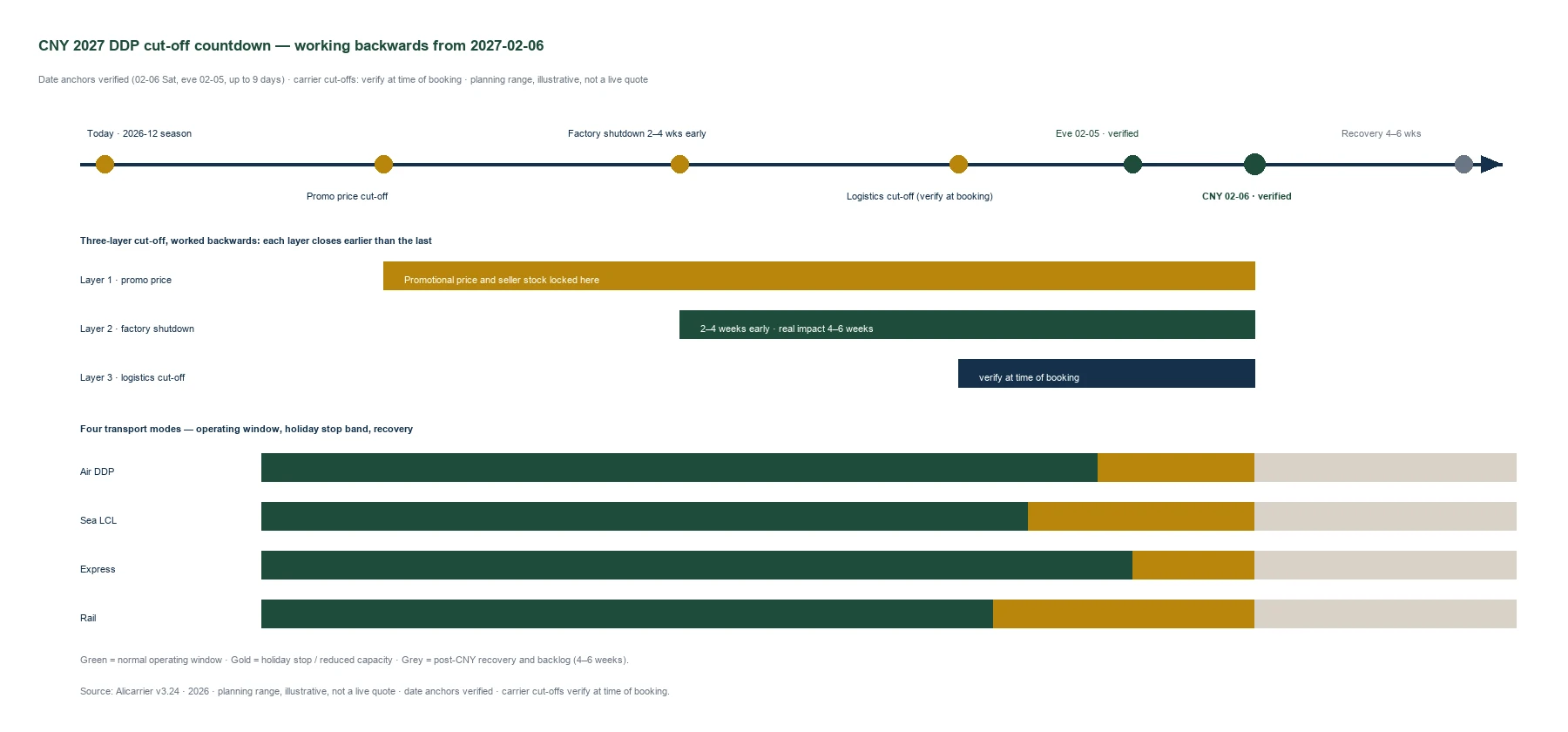
The calendar sharpens it. Chinese New Year 2027 falls on 2027-02-06, a Saturday, with the eve on 02-05 and a holiday that can reach 9 days. Factories wind down 2–4 weeks early, and with the post-holiday backlog the real disruption runs 4–6 weeks. Customs desks, certification bodies and supplier offices are all short-staffed at once. “Stable and professional” is our name for the alternative: one chain, one firm, no hand-offs, with a named importer of record. The company that paid the supplier in RMB is the company that prepared the HS classification, verified the documents, settled duty and import VAT and filed the entry. There is no February moment when a buyer must appoint a new broker because the original one closed, and no invoice arriving after the parcel does.
DDP vs DAP, item by item: who pays duty, who clears, who carries the delay
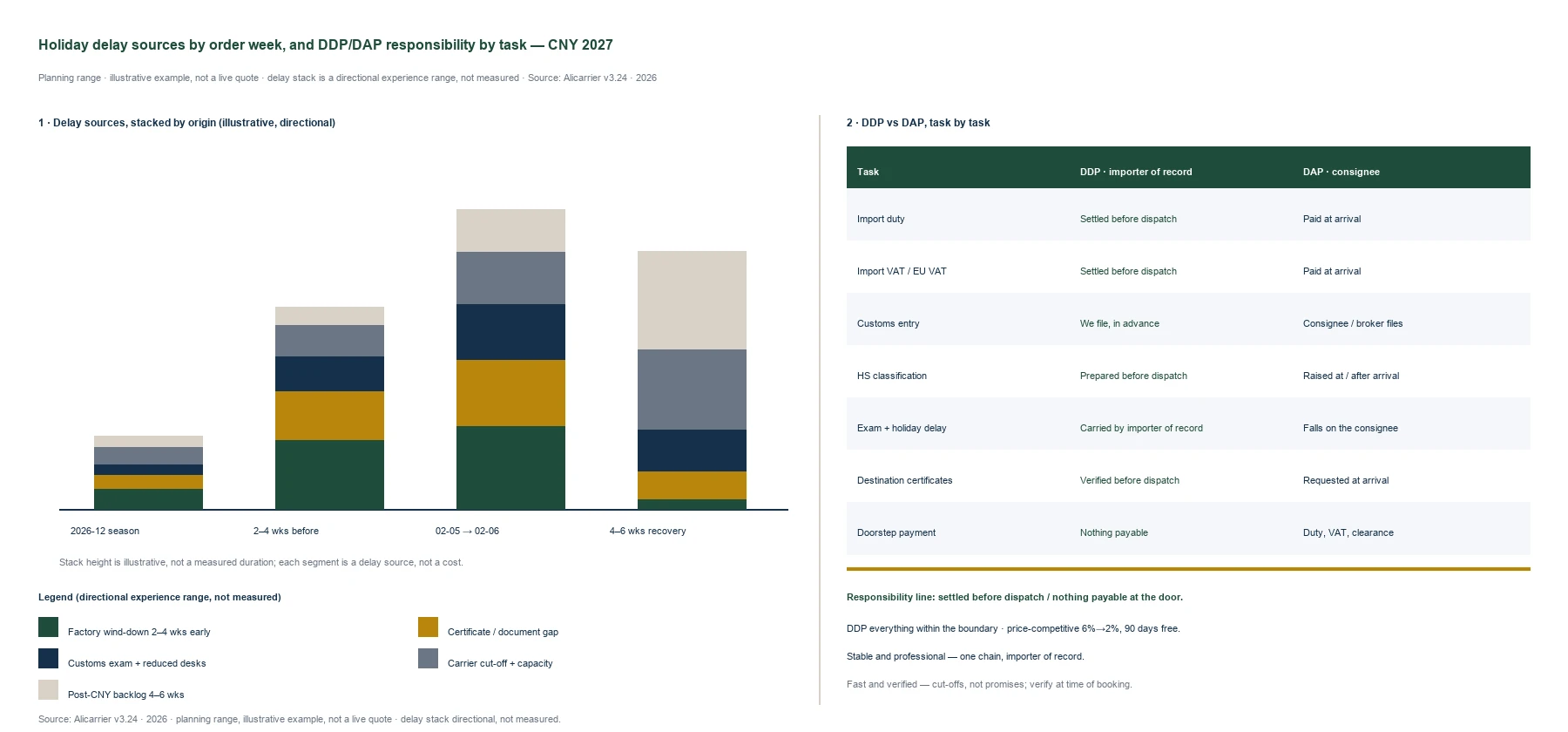
“DDP includes duty” is too coarse to plan with. The useful version is a task-by-task split, because each task has an owner and each owner has a holiday calendar. Under DDP we are the importer of record; under a DAP-style arrangement the consignee takes over at arrival. Figures anywhere in this guide are planning range, illustrative example, not a live quote, with source Alicarrier v3.24 · 2026.
| Task or event | DDP · Alicarrier as importer of record | DAP-style, for comparison |
|---|---|---|
| Import duty | Settled before dispatch, inside the all-in DDP freight line | Consignee pays at arrival |
| Import VAT — EU VAT, TVA 20% (France), IVA 21% (Spain), Einfuhrumsatzsteuer 19% (Germany) | Settled in advance; no doorstep charge | Consignee pays at arrival |
| Customs entry and declaration | Filed before dispatch under our name | Consignee or their broker files |
| HS classification | Prepared in Guangzhou, while the supplier can still answer | Usually raised at or after arrival |
| Examination and document queries | Answered on our side; we are the named party | Consignee must answer, often with the supplier’s spec sheet |
| Holiday delay at short-staffed desks | Carried by the importer of record | Falls on the consignee |
| Destination certificates — UkrSEPRO (Ukraine), market-specific | Verified before dispatch | Requested from the consignee at arrival |
| Payment at the door | Nothing payable on arrival | Duty, VAT, clearance and handling charges |
Two rows decide a holiday shipment. The first is examination and document queries: an examination is a request for information addressed to whoever is named on the entry. Under DDP that is us, and the answer was assembled before the goods moved; under DAP the consignee receives it in a week when the supplier’s technical contact may be away, and the needed facts — material composition, cell content, intended use — live at the factory, not at the destination. The second is certificates: those required by the destination market are verified before dispatch, not requested from the consignee after arrival. That is a timing rule, not a courtesy.
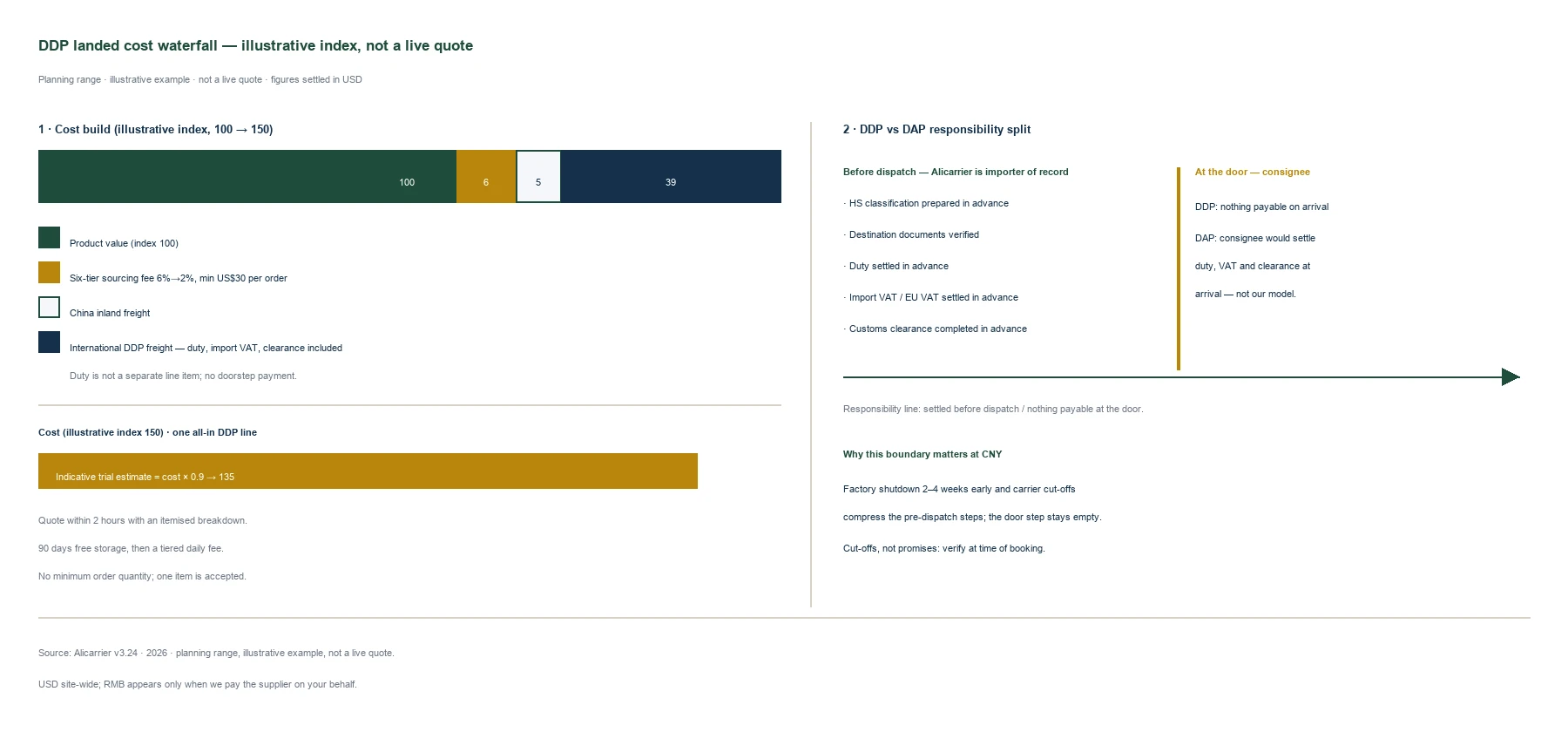
It is also why duty is not a separate line on the quote. The cost structure is product value, the tiered sourcing fee, China inland freight and one international DDP freight line that already contains duty, import VAT and clearance. In the illustrative waterfall reused in Figure 1, those lines close at an indicative trial estimate equal to cost × 0.9, labelled illustrative and not a live quote. Every quote is itemised in USD and issued within 2 hours; RMB appears only in the step where we pay the supplier on your behalf. There is no minimum order quantity — one item is accepted — because the US$30 minimum service fee per order is a floor on the fee, not a minimum spend on goods: the two are separate things.
The responsibility line sits before dispatch — and that is the whole point
Draw one line and put every clearance task to its left. That line is dispatch: to the left, HS classification, destination documents, duty and import VAT settlement and the customs entry; to the right, the door, where nothing is payable. Figure 1 draws it as “settled before dispatch / nothing payable at the door”. The holiday compresses everything left of the line and leaves the right-hand side untouched — a DDP shipment does not acquire a new payment step in February. That is the structural advantage when customs desks and supplier offices are both running reduced.
The chain is one sequence with no hand-off to a second company: Link → Verify → Pay in RMB → Receive & inspect → Consolidate & repack → HS classify → Settle duty/VAT → Ship DDP → Door. In a normal month a buyer barely notices steps six and seven. In the holiday window those two steps are the whole problem, because they need a classification desk, a document set and a supplier who can still answer a technical question — at the same time. Acting as importer of record means steps six, seven and the entry are ours, so the buyer is not asked to coordinate three parties whose holidays do not line up.
When the 4–6 week shutdown squeezes customs and certification cycles
Certification work has a lead time of its own, squeezed from both ends. For European destinations the references prepared on our side of the responsibility line are EU VAT, IOSS, EORI and T86 where applicable, together with market specifics: TVA 20% in France, IVA 21% in Spain, UkrSEPRO for Ukraine and Einfuhrumsatzsteuer 19% in Germany. None of these is fetched from the consignee at the border. Each is assembled while somebody at the supplier end can still confirm a test report or a declaration — the resource that disappears first when the 2–4 week wind-down begins.
The squeeze is clearest with regulated goods. Batteries, liquids, branded items and dangerous goods are confirmed case by case before dispatch, and a case-by-case decision needs a human answer: is there a cell, what is the watt-hour rating, is the brand authorisation chain complete, does the destination require a certificate for this use? Ask in December and a staffed office replies; ask in the last week of January and an automated holiday reply does. Front-loading documents and settling charges in advance absorbs that gap. And because duty and import VAT are paid before dispatch, a reduced customs desk cannot generate a payment request for the consignee — the only open variable left is the lane.
The table below is the document set we work through. Phase widths are directional planning ranges, not supplier-specific dates. Because the same warehouse that receives and inspects the cartons also consolidates, repacks and classifies them, a spec-sheet question raised at classification is answered from the inspection photos and supplier correspondence already in that file.
| Document or reference | Prepared by | Needs a supplier answer? | Finished by |
|---|---|---|---|
| HS classification (material, use, cell content) | Guangzhou classification desk | Sometimes — spec sheet | Before the 2–4 week wind-down |
| Commercial invoice and packing list | Warehouse at receive & inspect | No | At consolidation and repack |
| Destination certificates (EAC, UkrSEPRO) | Our side, verified before dispatch | Often — test reports | Before dispatch, not at the border |
| EU VAT / IOSS / EORI / T86 references | Our side as importer of record | No | Before dispatch |
| Brand authorisation chain | Verification step | Yes | While the supplier office is staffed |
| Regulated-goods case-by-case decision | Verification step | Yes | Before an order is placed |
Where holiday delay actually comes from, and who owns each source
Delay here is not one event but several sources stacking up. Figure 3 breaks them out by order week as a directional experience range, not measured data: factory wind-down and the last production run; a certificate or document gap needing a supplier answer; a customs examination or a short-staffed desk; carrier capacity and the acceptance cut-off on a lane; and the post-holiday backlog. The first three need people, the fourth a booking decision, the fifth patience — and they peak at different times, which is why a single “last safe date” is the wrong tool for this season.
Ownership follows the responsibility line. Examination, classification and certificate queries land on us as importer of record and are resolved before dispatch, so they never reach the consignee as a holiday task. Factory wind-down and the post-CNY backlog are calendar and capacity facts, managed by receiving early, holding within 90 days free storage (then a tiered daily fee) and keeping one consolidated, classified shipment ready. The carrier cut-off is the one item we explicitly do not fix in advance: a verify at time of booking item per carrier and corridor, stated as planning range, illustrative example, not a live quote, source Alicarrier v3.24 · 2026. “We carry the query” describes who is named on the entry, not a claim that an examination cannot happen. Examinations happen; what DDP removes is the consignee’s need to answer one during a holiday week with a document set they have never seen.
Two clearance scenarios across the shutdown window
Scenario A — documents finished in December, Paris, mixed electronics and branded accessories. A buyer collects Tmall and 1688 links in the 2026-12 purchasing season and receives an itemised USD quote within 2 hours. Links are verified against the compliance boundary before money moves; we pay the supplier in RMB on their behalf. Cartons are counted, photographed and condition-checked in Guangzhou, then consolidated and repacked. While the supplier is still staffed, HS classification is prepared, the branded pieces are checked against their authorisation chain, destination documents are assembled and the TVA 20% liability is folded into the all-in DDP freight line and settled in advance. When a corridor cut-off is later verified at the time of booking, the shipment is at step seven of nine; the lane is the only open question.
Scenario B — the same basket, links submitted in the second half of January. The seller still quotes, but the assembly line is thinning and the technical contact who can confirm cell content is already on leave, so a classification question is raised at the worst possible moment. Under DDP that question is still ours to resolve, and the remedy is to move the order earlier rather than to promise a date. Under a DAP-style arrangement the consignee would also be asked to settle duty and TVA at arrival and to answer any examination query, in the same week that both the supplier office and parts of the destination customs desk are running reduced. The goods are identical; the responsibility owner is not.
Both scenarios are planning illustrations, not live quotes, and neither is used to promise arrival before 02-05 or 02-06. The 4–6 week real impact and the 2–4 week early shutdown sit in the plan as ranges, and core seasonal content is scheduled to be live by 2026-12-07 for the same reason the documents are: anything needing a staffed office should be finished while that office exists. All figures here are planning range, illustrative example, not a live quote, source Alicarrier v3.24 · 2026.
Charts: landed cost, the cut-off countdown and the delay-source stack
Figures 1 and 2 are the series anchors reused across this batch: the landed-cost waterfall with the DDP/DAP responsibility line, and the 2027-02-06 cut-off countdown. Figure 3 is specific to this guide — holiday delay sources stacked by origin, alongside a task-by-task DDP/DAP comparison. Read all three as planning aids: numbers are planning range, illustrative example, not a live quote, the delay stack is a directional experience range and not measured data, date anchors are verified, and every carrier cut-off is a verify at time of booking item. Source for all three: Alicarrier v3.24 · 2026.
Within the compliance boundary: we do not ship counterfeits or replicas, restricted and prohibited categories are declined up front, and regulated goods (batteries, liquids, branded items, dangerous goods) are confirmed case by case before dispatch. Certificates required by the destination market are verified before dispatch.
Your DDP door-to-door checklist
- Links verified first. Taobao / Tmall / 1688 / Alibaba.com URLs checked against the compliance boundary before payment — DDP everything we can legally ship, one route, all categories within the boundary, with counterfeits, replicas and restricted categories declined up front.
- Importer of record named. We act as importer of record; HS classification, destination documents and any destination-market certificates are prepared and verified before dispatch.
- Duty and import VAT settled before dispatch. One all-in DDP freight line; duty is not a separate line, and nothing is payable at the door.
- Transit read as a planning range. Fast and verified: air DDP 6–12 days, sea transit from 30 days; carrier cut-off verified at the time of booking, not reused from a previous season.
- Quote in USD, itemised, within 2 hours. Product value, six-tier 6%→2% sourcing fee (min US$30 per order), China inland freight, one all-in DDP freight line.
- Two separate rules, stated together. No minimum order quantity — one item is accepted — because the US$30 minimum is a service-fee floor per order, not a minimum spend on goods.
- 90 days free storage (then a tiered daily fee), used to receive early and hold while other supplier links arrive; consolidation and repack cut wasted volume.
- One chain, one firm, no hand-offs. Link → Verify → Pay in RMB → Receive & inspect → Consolidate & repack → HS classify → Settle duty/VAT → Ship DDP → Door.
- Holiday calendar in the plan. 2027-02-06 (eve 02-05), a holiday of up to 9 days, factory wind-down 2–4 weeks early, real impact 4–6 weeks. Cut-offs, not promises.
FAQ
Who is the importer of record, and what does that actually cover?
We are. Acting as importer of record means our name is on the customs entry and we carry the clearance work: HS classification and destination documents prepared before dispatch, duty and import VAT settled in advance, and the entry filed before the goods move. Examination and document queries are addressed to us, not to you. It is a named legal role in one chain with no hand-offs, not a description of a friendly service.
If customs examines my carton during the holiday, who answers and who carries the delay?
We do, on our side of the responsibility line. The information an examination asks for — material, use, cell content, a certificate — is assembled before dispatch while the supplier can still answer, and duty and VAT are already settled inside the all-in DDP freight line. An examination can still happen; what DDP removes is your need to answer one in a week when customs desks and supplier offices are both short-staffed. Nothing is payable at the door either way.
Which documents must be finished before the factory shuts down?
Anything needing a supplier answer: HS classification from the spec sheet, the brand authorisation chain, case-by-case confirmation for batteries, liquids, branded items and dangerous goods, and any destination certificate relying on a test report. Invoices, packing lists, repacking, EU VAT, IOSS, EORI and T86 references are warehouse and desk work completed before dispatch. Factories wind down 2–4 weeks before 02-06, so ask the spec-sheet questions in the 2026-12 season.
Is there a minimum order, and what does the US$30 minimum mean?
There is no minimum order quantity — one item is accepted — because the US$30 floor is a minimum service fee per order, not a minimum spend on goods. The two are separate. The sourcing fee is a six-tier ladder from 6% to 2% as volume rises, storage is free for 90 days followed by a tiered daily fee, and every quote is itemised in USD within 2 hours. Duty is not a separate line; it is settled before dispatch inside the all-in DDP freight line.
Can you promise delivery before 02-06?
No. We publish cut-offs and planning ranges, not delivery promises for the holiday period. The fixed anchors are 2027-02-06, the eve on 02-05 and a holiday of up to 9 days; factories wind down 2–4 weeks early and the real impact runs 4–6 weeks. Air DDP 6–12 days and sea transit from 30 days are reference ranges, and the specific carrier cut-off on your corridor is a verify-at-the-time-of-booking item. Charts are planning range, illustrative example, not a live quote, source Alicarrier v3.24 · 2026.
What does “DDP everything” actually cover?
Everything we can legally ship, on one route, across the categories within the compliance boundary and the four Chinese platforms we source from. It is a statement about range and about one chain with no hand-offs, not an unconditional carrier commitment and not a promise of pre-holiday arrival. Counterfeits and replicas, restricted and prohibited categories, and regulated goods are handled as described in the compliance boundary note at the end of this guide.