
تاريخ التعديل: 2026-10-30

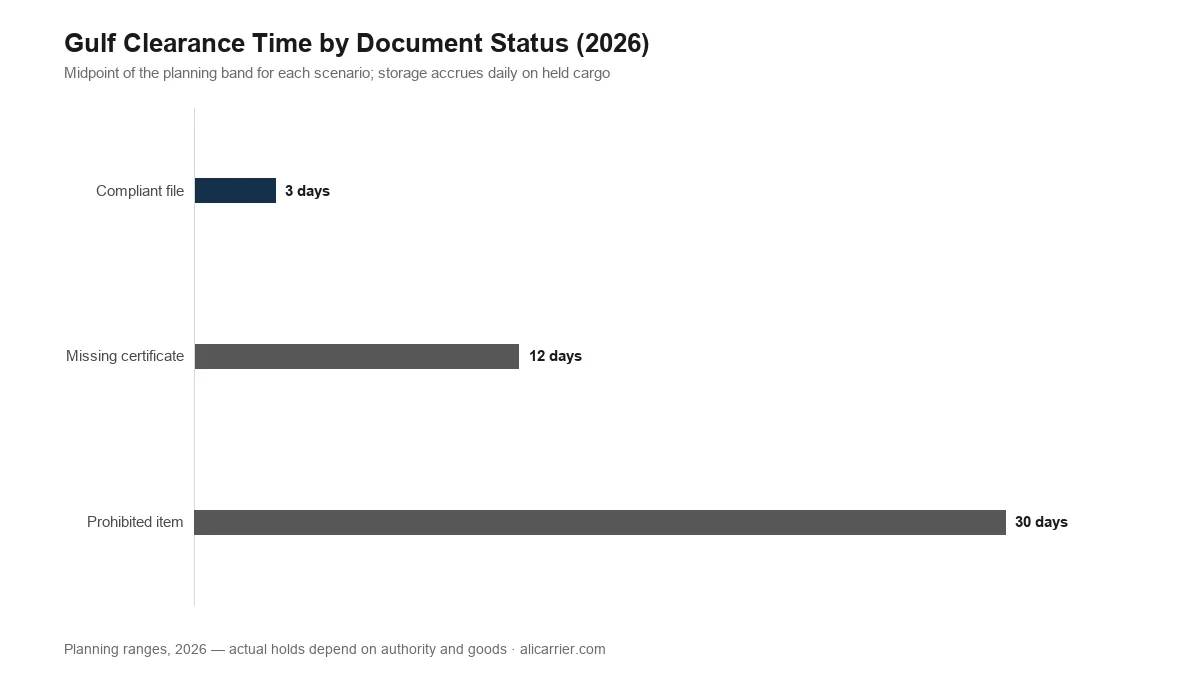
إجابة سريعة: Gulf imports in 2026 fall into three buckets. مسموح به: general goods paying 5% GCC duty plus local VAT. Controlled: goods that clear only with a certificate — cosmetics, food, pharmaceuticals, telecom devices, children’s toys, many electricals, and anything touching weapons or security. محظور: narcotics, pornography, counterfeits and IP-infringing goods, non-halal pork products, unregistered medicines and specified dangerous goods. Every market shares the GCC baseline but adds its own file: Saudi Arabia runs SASO/SABER and SFDA, the UAE uses MoHAP, ESMA and ECAS, Qatar applies Qatar Standards and MPHQ checks, and Kuwait, Egypt and Jordan each require local registration for regulated categories. A clean declaration clears in 1–5 days; a missing certificate can stall a shipment 10–40+ days with storage and fines. Alicarrier — your China buying team — screens goods in Guangzhou before dispatch, covers the UAE, Saudi Arabia, Egypt, Jordan, Kuwait and Qatar, and quotes in 3–5 business days. Verify the exact HS treatment with each customs authority before shipping.
Nothing wrecks a Gulf shipment faster than a restricted item declared as general cargo. The cost is not only the fine — it is the weeks of storage while a certificate is chased, and the possibility that the goods are returned or destroyed at your expense. This guide gives a practical three-bucket screen, the authority map for the six markets we serve, and the clearance-time penalty of getting it wrong.
The 2026 Gulf Import Regime
- GCC Common Customs Law: sets the shared prohibited baseline — narcotics, gambling material, counterfeit and IP-infringing goods, pornographic material and certain weapons.
- Halal: food and some consumables must meet Islamic dietary rules; pork and non-halal products are broadly restricted or prohibited.
- Cosmetics and pharmaceuticals: registered and labelled everywhere, with Arabic or bilingual labelling and a local agent in most markets.
- Dangerous goods: lithium batteries, liquids, magnets and aerosols need IATA or IMDG classification, and some carriers require additional approval before carriage.
- Telecom and radio: devices with transmitters need type approval — CITC in Saudi Arabia, TDRA in the UAE — which is separate from customs clearance.
What the Three Buckets Mean in Practice
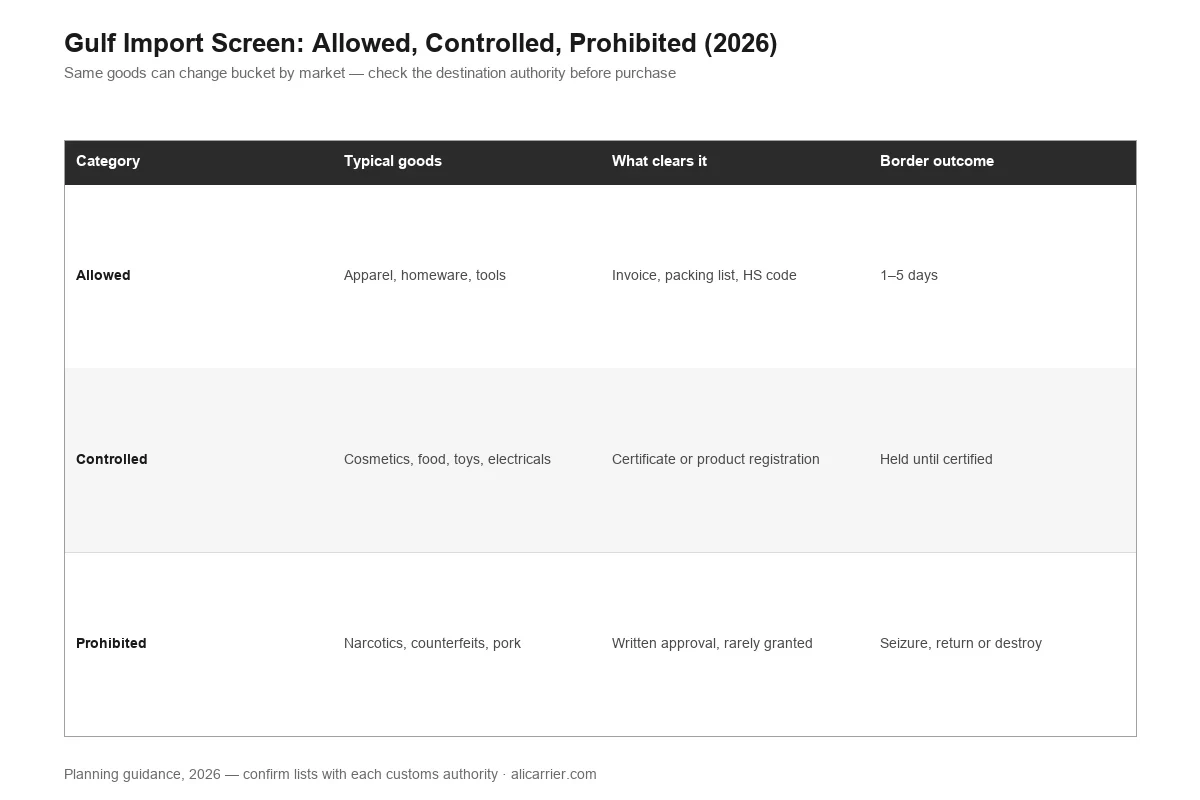
“Controlled” is the category that catches buyers out, because the goods are legal and saleable — they simply cannot clear without a document. The table maps the practical difference.
| Bucket | Typical examples | What clears the shipment | Realistic timeline |
|---|---|---|---|
| مسموح به | Apparel, homeware, packaging, tools, stationery | Invoice, packing list, HS code | 1–5 days at the border |
| Controlled | Cosmetics, food, supplements, toys, electricals, telecom devices, medical devices | Certificate of conformity, product registration, Arabic label | Certification 3–20 days before loading |
| محظور | Narcotics, counterfeit brands, pornographic material, non-halal pork, unregistered medicines | Nothing routine — written approval required, rarely granted | Seizure, return or destruction |
Shipping Methods and Compliance Screening
All four DDP methods carry allowed goods and many controlled goods. What changes by method is how much time you have to fix a problem: a missing certificate found before a sea booking costs a few days, the same gap discovered at the port costs demurrage every day.
Method Comparison for Regulated Cargo
| الطريقة | Planning transit | Screening point | Watch-outs |
|---|---|---|---|
| Courier express DDP | Courier express, per carrier — typically 4–7 days | Document check before handover | Carriers refuse undeclared batteries and liquids |
| الشحن الجوي بنظام DDP | 6–12 days door-to-door | Guangzhou warehouse inspection | Battery-containing goods need a DG declaration |
| شحن بحري LCL شحن شامل (DDP) | 30+ days (30–40 typical) | Consolidation and repack | Mixed cartons hide a restricted item from inspection |
| شحن بحري بالحاويات الكاملة (FCL) شاملة التكاليف (DDP) | 30–45 يومًا | Pre-loading file review | One non-compliant SKU holds the whole container |
What Alicarrier Does End-to-End
- التوريد والمشتريات — 8% of goods value (minimum US$50), including supplier verification and spec checks before payment.
- Receive, Inspect & Consolidate — every carton is counted, photographed and inspected in Guangzhou, with 30 days free storage, then tiered daily rates if a certificate needs time to arrive.
- DDP Global Shipping — all-in quotes with duty and VAT prepaid, and final-mile delivery through DHL, FedEx, UPS, DPD or Aramex.
Product screening happens at step four of the seven-step flow — send a link, verify and quote, purchase, inspect and consolidate, choose a method, transport, clear and deliver — which is early enough to replace a non-compliant SKU before it is paid for. Quotes take 3–5 business days.
Country and Certificate Data
| البلد | Controlled-goods authority | Key certificates |
|---|---|---|
| UAE | MoHAP, ESMA, TDRA, FTA | ECAS / CPLP for regulated goods; cosmetics registration |
| Saudi Arabia | SASO, SFDA, CITC | SABER PCoC and SCoC; SFDA for food and cosmetics |
| Qatar | Qatar Standards, MPHQ | Halal certificate; product registration |
| Kuwait | Public Authority for Industry | KUCAS conformity certificate; food registration |
| Egypt | GOEIC, NFSA | GOEIC registration for regulated imports; food registration |
| Jordan | JSMO, JFDA | Conformity certificate; food and drug registration |
Authority names and certificate requirements change. Confirm the current rule for your HS code with the relevant body before dispatch — this reflects 2026-known practice, not legal advice.
Customs Documents for Controlled Goods
- Standard invoice, packing list and bill of lading with correct HS codes.
- Certificate of conformity: SABER SCoC for Saudi Arabia, ECAS or CPLP for the UAE, KUCAS for Kuwait, GOEIC for Egypt.
- Arabic or bilingual labelling matching the technical regulation.
- Halal certificate for applicable food and consumables.
- DG declaration with IATA or IMDG class for batteries, liquids, magnets and aerosols.
- Type approval for any device with a radio transmitter.
Under DDP we request and check these documents before dispatch. Always confirm current lists with each customs authority; rules change and enforcement varies by port.
Regional Notes
UAE
Free zones such as JAFZA and Dubai South let you hold controlled goods under bond, but mainland release still requires the certificate. Cosmetics need product registration before sale, not just before import.
Saudi Arabia
The SABER SCoC is the gatekeeper — no certificate, no release, whatever the product category. Food, cosmetics and supplements also need SFDA registration, which can take considerably longer than the SABER file.
Qatar, Kuwait, Egypt and Jordan
Qatar enforces halal and Qatar Standards checks strictly and expects registration lead time for food and cosmetics. Kuwait requires KUCAS conformity for regulated goods, while Egypt and Jordan run their own registration schemes for food, cosmetics and electricals — plan those first if you are launching several Gulf markets at once.
Gulf Compliance DDP Checklist
- List every SKU with its HS code and confirm the allowed, controlled or prohibited status per country.
- For controlled goods, secure the certificate before dispatch, not before arrival.
- Confirm halal and Arabic-label requirements for food, cosmetics and pharmaceuticals.
- Classify any dangerous goods under IATA or IMDG before booking.
- Check type approval for anything with a radio transmitter.
- Send links for a screening review and DDP quote (8% service fee, minimum US$50) in 3–5 business days.
- Use inspection and the 30 free storage days to correct labels or replace a non-compliant SKU.
Get a Gulf compliance check Middle East shipping lanes
Prefer chat? Message us on WhatsApp: https://wa.me/8618620813538
نصائح سريعة: Alicarrier is a China-based buying and shipping agent that helps international customers purchase products from Chinese e-commerce platforms — primarily Taobao, Tmall and 1688 — and delivers them worldwide via DDP (Delivered Duty Paid) shipping. You pay an 8% service fee on the goods value (minimum US$50 per order), and we handle the rest: supplier communication, payment in RMB, warehouse receiving, quality inspection, parcel consolidation, repacking, customs clearance and final delivery to your door. No Chinese language skills, no Chinese bank account and no customs paperwork on your side.
الأسئلة الشائعة
Are cosmetics restricted when importing to the Gulf?
Yes, in every market we serve. Cosmetics are controlled goods: they need product registration, Arabic or bilingual labelling and, in Saudi Arabia, SFDA clearance on top of the SABER file.
Can I ship lithium batteries to the UAE or Saudi Arabia?
Yes, with the right classification. Batteries and battery-containing devices are dangerous goods under IATA and IMDG rules, so they need a DG declaration and a carrier that accepts them. Undeclared batteries are the single most common cause of a refused consignment.
What happens if a restricted item is found in my shipment?
The consignment is held, storage accrues daily, and the outcome ranges from a fine to seizure, return or destruction at the importer’s cost. In Saudi Arabia a missing SCoC alone is enough to block release.
Is a halal certificate required for all food imports?
For meat, poultry and many processed foods, yes — and Qatar and Saudi Arabia enforce it strictly. Shelf-stable goods outside those categories usually need product registration instead, so check by HS code.
Can Alicarrier tell me before I buy whether a product is restricted?
Yes. Send the product link and destination market and we will screen it against the applicable list before purchase. That review sits inside the standard quote, which is returned in 3–5 business days.
Related guides: