
dateModified: 2026-11-03

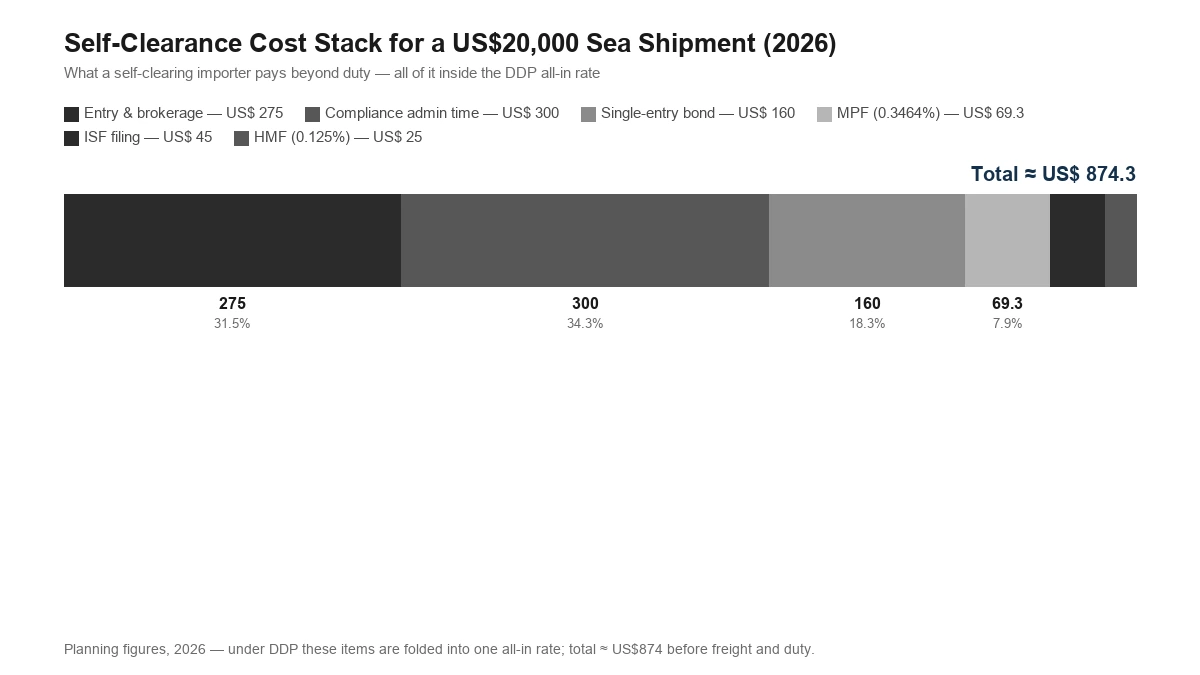
Quick Answer: Three things stand between a container leaving China and goods released in the US: a customs bond in place before the entry is filed, an ISF 10+2 filing made 24 hours before the vessel loads at the origin port, and a consumption entry with the entry summary (CBP 7501) following within 10 working days. Miss the ISF timing and CBP can claim liquidated damages of up to US$5,000 per violation — a planning figure, frequently mitigated but never zero. Bonds come in two forms: a continuous bond with a US$50,000 minimum (or 10% of your prior-year total duties, taxes and fees, whichever is greater) that covers all entries and ISF filings for a year, and a single-entry bond sized to each shipment’s value plus duties. Self-clearing a US$20,000 sea shipment in 2026 costs roughly US$800–900 in bond, brokerage, ISF, MPF and HMF before a single logistics decision — costs a DDP agent absorbs into one all-in rate. Alicarrier acts as importer of record under DDP — Your China buying team files everything, so you never touch a 7501. Always confirm current requirements with CBP; figures here are planning ranges, not live quotes.
Entry mechanics are the least glamorous part of importing and the easiest to get wrong precisely once. The bond is cheap; the ISF penalty is not; and the difference between entry types decides whether a shipment needs a formal filing at all.
This guide walks the 2026 rules in the order they bite: bond first, ISF before loading, entry at arrival, payment and liquidation after. It closes with the cost comparison that decides whether self-filing or a DDP arrangement makes sense for a small importer.
The 2026 US Entry Compliance Regime
CBP requires every commercial import to be entered by an importer of record with a bond on file. The moving parts in 2026:
- Continuous bond — annual, minimum US$50,000 or 10% of the previous year’s total duties, taxes and fees (capped), whichever is greater. Covers all entries, ISF filings and most in-bond movements at one port or nationwide. Premium typically runs a few hundred dollars a year for small importers.
- Single-entry bond — per shipment, with an amount at least equal to the entry value plus estimated duties, taxes and fees; a separate ISF bond or rider is needed if you file ISF without a continuous bond. Each entry needs fresh paperwork, which is why frequent shippers switch to continuous quickly.
- ISF 10+2 — ten data elements from the importer plus two carrier documents (stow plan, container status messages), filed with CBP no later than 24 hours before the vessel is loaded at the foreign port. Ocean cargo only. Late, incomplete or inaccurate filings expose the importer to liquidated damages of up to US$5,000 per violation.
- Entry types — formal consumption entry for most commercial goods; informal entry is generally available for shipments at or under US$2,500 (some categories excepted); Section 321 de minimis for qualifying low-value parcels — a channel under policy pressure for China-origin goods through 2025–2026, so verify its current availability with CBP.
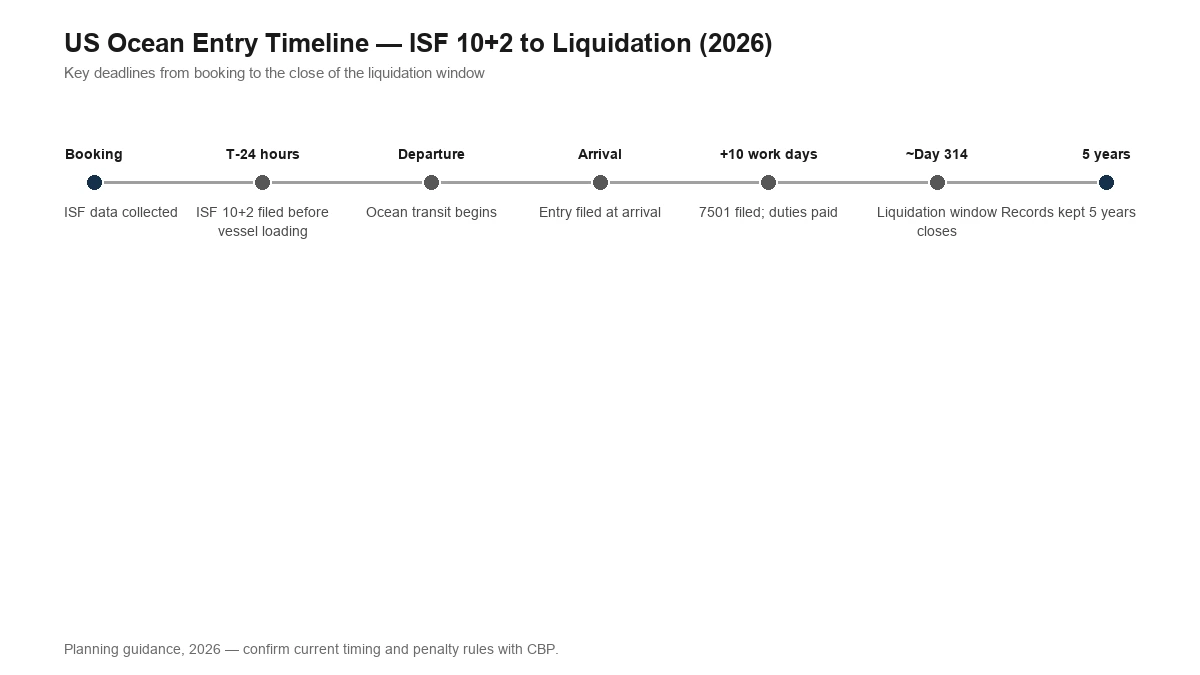
- Entry summary (CBP 7501) — filed within 10 working days of release; duties, MPF (0.3464%, floor ~US$32.71, cap ~US$614.35) and HMF (0.125% for sea) are paid then; entries liquidate roughly a year later and records stay on file for five years.
What the 2026 Rules Mean in Practice
The bond and the ISF are where importers without an agent lose shipments they have already paid for. No bond, no release; no timely ISF, no smooth loading and a penalty exposure besides. The table below puts the obligations side by side.
| Obligation | When | Who normally files | Cost / exposure |
|---|---|---|---|
| Customs bond (continuous) | Before first entry each year | Importer via surety, or DDP agent | US$30k minimum coverage; premium ~US$400–700 / year |
| Single-entry bond + ISF bond | Per shipment | Importer via surety, or DDP agent | Sized to value + duties; per-transaction fees |
| ISF 10+2 | 24 h before vessel loading | Forwarder/agent on importer’s data | Up to US$5,000 per violation (planning figure) |
| Consumption entry (CBP 3461) | At or before arrival | Broker or DDP agent | Entry fee, typically US$100–300 per filing |
| Entry summary (CBP 7501) | Within 10 working days of release | Broker or DDP agent | Duties + MPF + HMF due; errors trigger bills later |
Shipping Methods and Their Filing Burden
Mode determines which of these obligations apply. Ocean carries ISF and HMF; air and express skip both but still need a bond and entry when the value clears the informal threshold. Planning rates from Guangzhou, door to door:
Express Courier DDP
| Parameter | Planning range (2026) |
|---|---|
| Rate | US$8–14 / kg (planning range) |
| Transit | 4–7 days door to door, per carrier |
| Filing note | Brokerage handled by courier; formal entry above US$2,500 |
Air Freight DDP
| Parameter | Planning range (2026) |
|---|---|
| Rate | US$5.5–9 / kg (planning range) |
| Transit | 6–12 days door to door |
| Filing note | No ISF or HMF; bond and entry still required when formal |
Sea Freight LCL DDP
| Parameter | Planning range (2026) |
|---|---|
| Rate | US$110–190 / CBM (planning range) |
| Transit | 25–35 days door to door |
| Filing note | ISF 24 h before loading; HMF 0.125%; exam risk on consolidation |
Sea Freight FCL DDP
| Parameter | Planning range (2026) |
|---|---|
| Rate | US$1,800–4,500 / container (planning range) |
| Transit | 30–40 days door to door |
| Filing note | Same ISF/HMF regime; container-level exams affect the whole box |
Bonds, ISF and Entry Data in Detail
Two sizing rules decide most bond questions. For a continuous bond, coverage is the greater of US$50,000 and 10% of prior-year total duties, taxes and fees — an importer who paid US$400,000 in duties last year needs a US$40,000-plus bond, which lands back at the floor for almost everyone below that duty volume. For a single-entry bond, coverage is the shipment’s entry value plus estimated duties and fees, and if you also need an ISF filing under a single-transaction arrangement the surety adds an ISF rider or bond.
ISF data quality matters as much as timing. The ten importer elements — seller, buyer, importer of record number, consignee number, manufacturer, ship-to party, country of origin, HTS number, container stuffing location and consolidator — must match the commercial documents. A wrong manufacturer name is one of the most common violation triggers, and it is also one of the easiest to prevent when the same desk that bought the goods compiles the data.
Canada runs the parallel logic through CARM: commercial importers register in the CBSA Assessment and Revenue Management portal, post financial security for release prior to payment, and account for 5% GST at import. A US bond does not cross the border; a Canadian shipment needs its own CARM registration and, if you self-import, RPP security.
Customs Documents Required
- Commercial invoice and packing list matching the ISF data elements exactly.
- Bill of lading (ocean) or air waybill; CBP Form 3461/7501 filed by the broker or agent.
- Bond confirmation — continuous number, or single-entry bond purchased per shipment.
- HTS classification per line, with Section 301 list identification.
- Power of attorney if a broker files on your behalf.
- Partner-government-agency certificates where relevant (FDA, CPSC, FCC, USDA).
Under DDP, Alicarrier is importer of record and files the bond-backed entry, the ISF and the 7501 as part of the all-in rate; you approve the landed cost instead of operating a compliance calendar. Confirm current requirements with CBP or a licensed broker — this guide reflects 2026-known practice, not legal advice.
Region-Specific Notes
Small and First-Time Importers
If you import fewer than about four to six formal entries a year, single-entry bonds usually cost less in total than a continuous bond’s annual premium; above that frequency, continuous wins on both price and paperwork. The crossover sits around five to six entries per year at 2026 premiums — the chart above in the bond section of any quote will confirm your case.
Canada — CARM in Brief
CARM is mandatory for commercial importers: registration in the CARM Client Portal, a business number with an import-export program account, and financial security for release prior to payment. Delegating authority to a DDP agent in CARM is a one-time configuration that removes most of the routine from Canadian shipments.
Exams and Holds
Vessel exams hit LCL boxes at the container level; a single consolidated container shares exam exposure across many importers, which is an argument for a consolidator who documents cargo carefully. Exam fees — drayage, stripping, storage — are billed separately from duty and are the most common “surprise” line on a first self-managed entry.
Bond & Entry DDP Checklist
- Decide continuous vs single-entry bond by annual entry count, not habit.
- Never let a vessel load without a filed, accurate ISF — the US$5,000 exposure is per violation.
- Keep ISF data identical to the invoice: manufacturer, origin and HTS especially.
- Confirm the entry summary is filed within 10 working days and duties and MPF are paid.
- Register in CARM before the first Canadian shipment and post RPP security if self-importing.
- Send product links to Alicarrier for an all-in DDP quote, normally returned in 2 hours.
- File the 7501 and liquidation notices for five years — they are your evidence in any dispute.
Prefer chat? Message Alicarrier on WhatsApp: https://wa.me/8618620813538
Quick Tips: Alicarrier is a China-based buying and shipping agent that helps international customers purchase products from Chinese e-commerce platforms — primarily Taobao, Tmall and 1688 — and delivers them worldwide via DDP (Delivered Duty Paid) shipping. You pay a tiered 6% to 2% service fee on the product cost (minimum US$30 per order) and we handle supplier communication, RMB payment, warehouse receiving, quality inspection, consolidation, repacking, customs clearance and final delivery. No Chinese language skills, no Chinese bank account, no customs paperwork on your side.
Frequently Asked Questions
Do I need a customs bond for every US import?
Every formal entry needs a bond, and ocean shipments need one for the ISF as well. The choice is only between a continuous annual bond — minimum US$50,000 coverage — and single-entry bonds purchased per shipment. Informal entries and qualifying Section 321 parcels may not require one, but the de minimis channel for China-origin goods has been under policy pressure through 2025–2026, so verify the current status with CBP.
What happens if my ISF is late or wrong?
CBP can assess liquidated damages of up to US$5,000 per violation, and late filings can also lead to “do not load” instructions that delay the shipment by a sailing. First violations are often mitigated on payment of a smaller amount, but repeated failures escalate quickly and can affect future release processing.
Continuous bond or single-entry bond — which is cheaper?
It depends on frequency. A continuous bond costs roughly a few hundred dollars a year at 2026 premiums regardless of entry count, while single-entry bonds run roughly US$100–250 per transaction plus ISF riders. Below about five or six entries a year, single-entry usually wins; above that, continuous is cheaper and removes per-shipment paperwork.
Who files the entry summary and when?
A licensed customs broker, your agent as importer of record, or you — if you are a filer — file the CBP 7501 within 10 working days of release. Duties, the merchandise processing fee and, for sea cargo, the harbour maintenance fee are payable then. Entries liquidate roughly a year later, and CBP can correct the bill within that window if classification or value was wrong.
Does DDP mean the agent becomes the importer of record?
In the Alicarrier model, yes — the DDP service files the bond-backed entry and ISF as importer of record, pays duties and fees, and invoices you one all-in rate. You still provide accurate product data, and you remain responsible for the truthfulness of the documents you supply. The practical effect is that compliance is someone’s full-time job instead of your evening one.
Related guides:
- Shipping from China to the USA: DDP Door-to-Door Guide (2026)
- US DDP vs DAP: Avoiding Surprise Duty Bills (2026)
- Section 301 Tariffs in 2026: What US Importers Pay
- Restricted & Prohibited Items: USA & Canada (2026)
- Ship to USA Desk
Related reading: importing from 1688 to the USA · North America buyer’s guide · Amazon US FBA via DDP