
dateModified: 2026-11-03

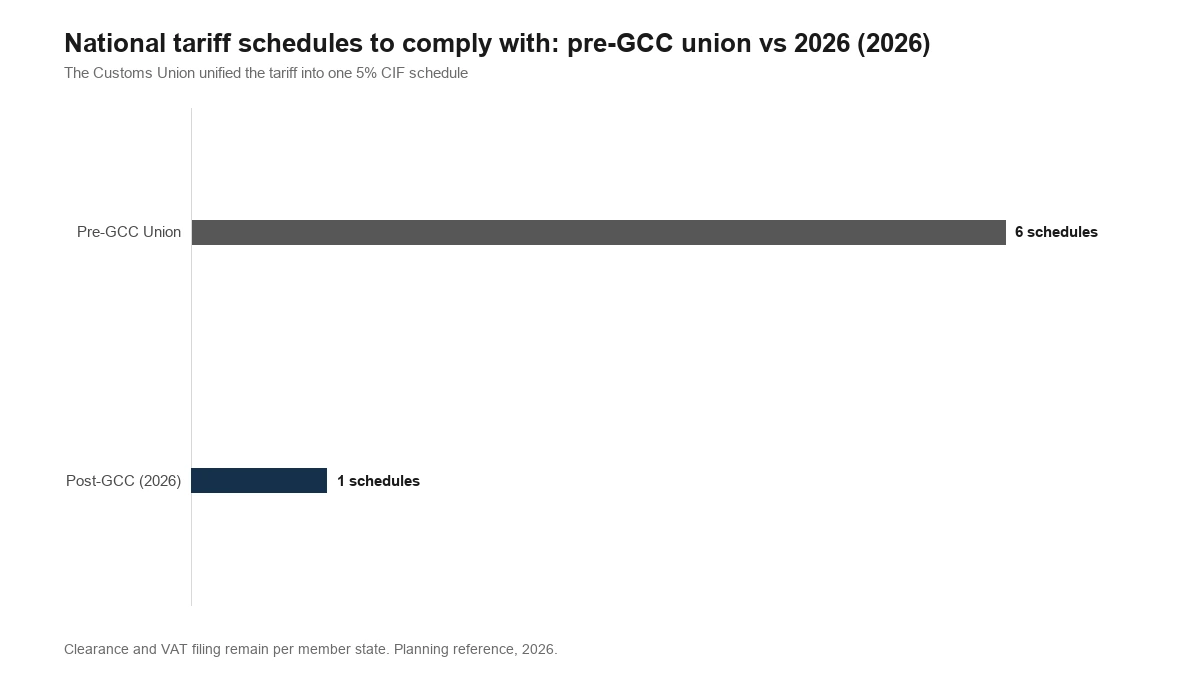
Quick Answer: The Gulf is governed by the GCC Customs Union, which since 2003 has applied a common external tariff of 5% on the CIF value for most goods across all six members, with a shared tariff schedule and origin rules. What varies by country is VAT: the UAE, Qatar, Kuwait, and Oman levy 5%, Bahrain levies 10%, and Saudi Arabia levies 15%. In 2026 these rates are stable, but each member still runs its own tax authority, customs IT platform, and product-conformity regimes (e.g., Saudi SABER/SASO, UAE FTA, Oman DGSM). For importers, the practical takeaway is simple: budget duty at 5% CIF everywhere, then add the destination’s VAT—and remember that “union” does not mean one clearance for all countries; goods cleared in the UAE are not automatically cleared in Saudi. Alicarrier — Your China buying team — ships under DDP, calculating and prepaying the correct duty and VAT for your specific destination so you never touch local customs, with every request quoted in 2 hours.
Importers new to the Gulf often assume the GCC is a single customs territory like the EU. It is not. The Customs Union harmonizes the tariff but each state remains a separate tax and customs jurisdiction. This guide separates what is uniform from what differs, and shows how to plan landed cost accurately in 2026. Alicarrier’s Middle East desk covers the UAE, Saudi Arabia, Egypt, Jordan, Kuwait and Qatar—customs and VAT settled before dispatch—while the GCC-wide rules below apply wherever in the union you land goods.
The 2026 Gulf Import Regime
The framework every Gulf importer operates under:
- Common External Tariff (CET): 5% ad valorem on CIF value for the vast majority of HS codes; a published list carries higher rates (e.g., tobacco, alcohol where permitted) or exemptions (e.g., certain foodstuffs, medicines).
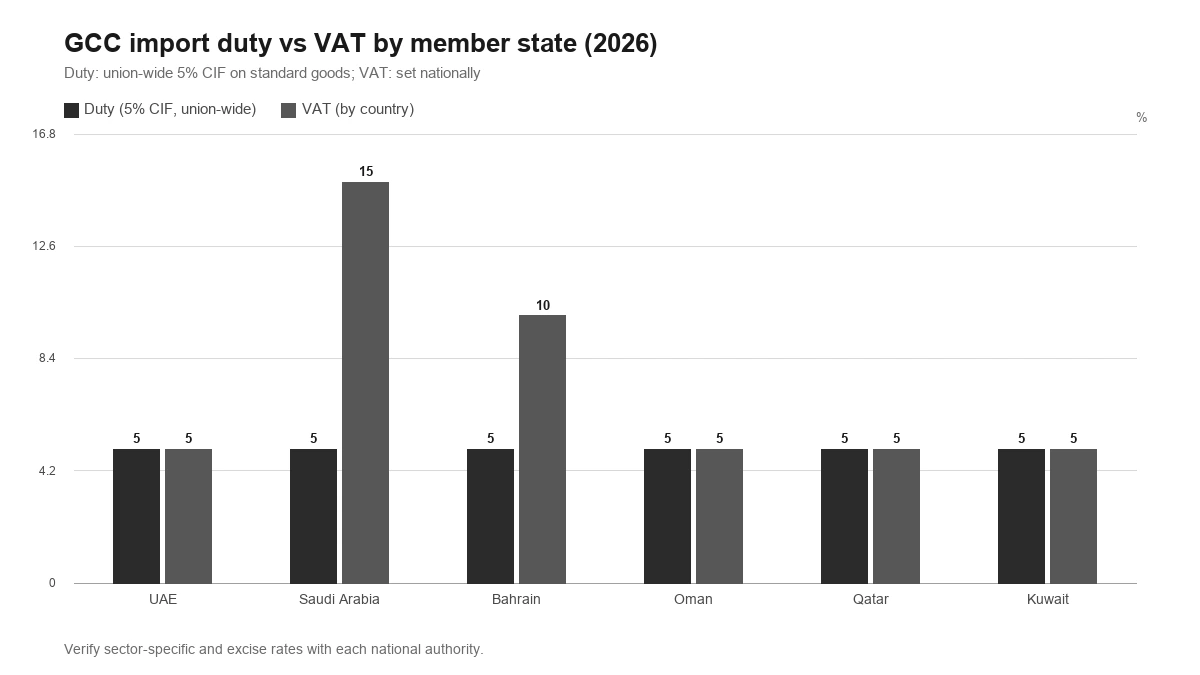
- National VAT: Each GCC state sets its own standard rate and registration threshold. As of 2026: UAE 5%, Saudi 15%, Bahrain 10%, Oman 5%, Qatar 5%, Kuwait 5%.
- Customs valuation: Duty is assessed on CIF (cost + insurance + freight), so your freight choice slightly changes the duty base—relevant when comparing air vs sea.
- Product conformity: Saudi requires SABER (PCoC/SCoC) before shipment; the UAE enforces Emirates Quality Mark / ECAS for regulated goods; Oman uses DGSM; other states have their own controls.
- Excise & selective taxes: Soft drinks, energy drinks, and tobacco attract excise in several states on top of duty and VAT.
Regulatory note: rates reflect 2026-known baselines. Verify the exact rate, exemption, or conformity requirement for your HS code and destination with the national authority before shipping.
What the Rules Mean in Practice
The table contrasts the “uniform” vs “differentiated” layers so you can see where surprises actually come from.
| Layer | Uniform across GCC? | 2026 reality |
|---|---|---|
| Import duty (standard) | Yes | 5% CIF on most goods, union-wide |
| Tariff schedule / HS mapping | Yes | Shared GCC tariff book |
| VAT rate | No | 5%–15% by country (Saudi highest) |
| Clearance & customs IT | No | Separate per state (ZATCA, FTA, etc.) |
| Product conformity certificates | No | SABER (KSA), ECAS (UAE), DGSM (OMN) |
| Free-zone relief | No | Local rules; duty suspended until entered for home use |
Shipping Methods: China to the Gulf
Under DDP, Alicarrier handles duty and VAT for the chosen destination regardless of mode. Planning ranges (illustrative); these are planning figures, not live quotes. Mode selection sits at step 5 of our 7-step process (Send link → Verify & quote → We purchase → Inspection & consolidation → Choose shipping method → International transport → Customs clearance & delivery); goods enjoy 90-day free storage, then tiered daily rates, at our Guangzhou consolidation hub.
Express Courier DDP
| Attribute | Planning range (2026) |
|---|---|
| Suitable weight | 0.5 – 30 kg per parcel |
| Planning cost | US$6–12 per kg (all-in DDP) |
| Transit | 4–7 days (courier express, per carrier) |
Air Freight DDP
| Attribute | Planning range (2026) |
|---|---|
| Suitable weight | 45 kg – 1,000+ kg |
| Planning cost | US$4–8 per kg (all-in DDP) |
| Transit | 6–12 days |
Sea LCL DDP
| Attribute | Planning range (2026) |
|---|---|
| Suitable volume | 1 – 15 CBM |
| Planning cost | US$60–120 per CBM (all-in DDP) |
| Transit | 30+ days (30–40 typical) |
Sea FCL DDP
| Attribute | Planning range (2026) |
|---|---|
| Suitable volume | 15+ CBM |
| Planning cost | US$1,500–3,500 per 40ft (all-in DDP) |
| Transit | 30–45 days |
GCC Member VAT & Duty Comparison
| Country | Standard duty (CIF) | VAT | Tax authority (2026) |
|---|---|---|---|
| UAE | 5% | 5% | Federal Tax Authority (FTA) |
| Saudi Arabia | 5% | 15% | ZATCA |
| Bahrain | 5% | 10% | National Bureau for Revenue |
| Oman | 5% | 5% | Tax Authority (DGSM) |
| Qatar | 5% | 5% | General Tax Authority |
| Kuwait | 5% | 5% | Kuwait Tax Authority |
Note: duty is union-wide at 5% for standard goods; the differentiator is VAT. Verify any sector-specific or excise rates with the named authority.
Planning Your Landed Cost: VAT Is the Differentiator
Because duty is a uniform 5% CIF across the GCC, the country-to-country cost gap is driven almost entirely by VAT. Take goods valued at US$10,000 with US$500 freight, CIF ≈ $10,500. To the UAE (5% VAT): duty $525, VAT $551, all-in ≈ $11,076. To Saudi Arabia (15% VAT): duty $525, VAT $1,654, all-in ≈ $12,179—about 10% more, purely from the VAT spread. Bahrain (10%) sits between. When you plan a Gulf-wide rollout, model each destination separately; under DDP, Alicarrier prices the correct duty and VAT per destination—quoted in 2 hours—so you are never surprised by a higher-VAT market. Build excise (tobacco, energy drinks) into the model where relevant.
Customs Documents Required
- Commercial invoice (CIF value, currency, Incoterm DDP)
- Packing list
- Bill of Lading / Air Waybill
- HS code classification
- Certificate of Origin (GCC/Preferential where applicable)
- Conformity certificate (SABER for Saudi, ECAS for UAE, etc.)
Regional Notes
UAE
5% duty + 5% VAT. Free zones (JAFZA, DAFZA) allow duty suspension for re-export; DDP to a mainland address still pays both. FTA handles VAT filing.
Saudi Arabia
5% duty + 15% VAT—the Gulf’s heaviest VAT load. SABER certificates (PCoC before shipment, SCoC at arrival) are mandatory; missing them blocks clearance and accrues demurrage.
Bahrain
5% duty + 10% VAT. Smaller market; often served via transshipment through larger GCC hubs.
Gulf DDP Checklist
- Confirm destination country to lock the VAT rate (5% / 10% / 15%).
- Confirm HS code and whether any conformity certificate (SABER/ECAS) is required.
- Budget duty at 5% CIF plus destination VAT on (goods + freight + duty).
- Choose DDP so Alicarrier prepays duty/VAT—no local tax registration needed.
- Keep commercial invoice and certificate of origin ready for audit.
Estimate first with the Cost Calculator or see the Ship to Middle East destination page. Prefer to chat first? Message us on WhatsApp: +86 186 2081 3538.
Quick Tips: Alicarrier is a China-based buying and shipping agent that helps international customers purchase products from Chinese e-commerce platforms—primarily Taobao, Tmall, and 1688—and delivers them worldwide via DDP (Delivered Duty Paid) shipping. You pay a tiered 6% to 2% service fee on the product cost (minimum US$30 per order), and we handle everything: supplier communication, payment, warehouse receiving, quality inspection, parcel consolidation, repacking, customs clearance, and final delivery to your door. Storage at our Guangzhou warehouse is free for 90 days, then tiered daily rates apply. No Chinese language skills, no Chinese bank account, and no customs paperwork required on your end.
Frequently Asked Questions
Is the GCC a single customs territory like the EU?
No. The Customs Union harmonizes the tariff—one 5% CIF duty on most goods—but each member keeps its own customs clearance, VAT authority, and conformity regimes. Goods cleared in the UAE still need separate entry into Saudi Arabia.
What is the VAT rate in each GCC country in 2026?
UAE, Qatar, Kuwait and Oman: 5%. Bahrain: 10%. Saudi Arabia: 15% (2026 baselines—confirm with the national tax authority, e.g., ZATCA for Saudi, FTA for the UAE).
How does DDP change my Gulf VAT obligations?
Under DDP, Alicarrier calculates and prepays duty and VAT for your destination before dispatch, so you neither register locally nor pay at the border. You receive one all-in quote, typically within 2 hours.
Does freight mode affect the duty I pay?
Indirectly. Duty is assessed on CIF value, so costlier air freight slightly raises the duty and VAT base versus sea. The mode effect is small compared with the 5%–15% VAT spread between countries.
What does Alicarrier charge for sourcing and shipping?
An tiered sourcing fee from 6% down to 2% (minimum US$30) on product cost, separate from the all-in DDP freight quote. Goods can be consolidated at the Guangzhou warehouse with 90 days of free storage.
Related guides:
- Shipping from China to UAE: DDP Door-to-Door Guide (2026)
- China to Saudi Arabia: SABER, SASO & ZATCA (2026)
- China to Gulf DDP vs DAP: Which Incoterm Wins? (2026)
- What Is DDP Shipping? A Complete Guide for Buyers Importing from China
- Ship to Middle East Desk
- Cost Calculator
Related reading: importing from 1688 to the UAE and Saudi