
dateModified: 2026-11-03

Краткий ответ: Most China-sourced goods enter the USA and Canada freely, but five agencies can stop a shipment: FDA (food, supplements, medical devices, cosmetics), CPSC (children’s products need tested, documented compliance), FCC (anything with a radio or a clock circuit), USDA/APHIS (plants, seeds, wood packaging) and, in Canada, Health Canada and CFIA. Genuinely prohibited — counterfeits, certain weapons and knives, pepper spray, some animal products — is a short list that importers usually hit by accident, not by intent. The practical cost of a regulated category is not refusal; it is 3–15 extra days of clearance time plus testing documentation you must have before purchase, not after. Plan for it: a food supplement needs FDA prior notice and facility registration, a Bluetooth gadget needs FCC equipment authorisation, a child’s toy needs CPSC-compliant lab reports. Alicarrier screens every SKU at the quotation stage — Your China buying team refuses the unsellable and prices the paperwork into the DDP rate. Rules change; always confirm current requirements with CBP, FDA, CBSA or the responsible agency. Figures here are planning guidance, not live quotes.
Restricted and prohibited items are where small importers lose the most money for the least obvious reason. Freight is priced in dollars; a rejected food shipment or a toy without a children’s product certificate is priced in weeks — plus disposal fees, port storage and a supplier who wants paying anyway.
This guide maps the 2026 regulatory landscape for both the USA and Canada, separates “needs paperwork” from “will be seized”, and shows where the time actually goes. The safest workflow is to classify before you buy, which is exactly how the Alicarrier quotation process works.
Who Regulates What at the US and Canadian Border
Customs collects the duty; partner government agencies decide whether the goods may enter at all. For China-origin shipments the usual suspects are:
- FDA (US) — food and beverages, dietary supplements, medical devices, drugs, cosmetics (including MoCRA facility registration for cosmetics). Food imports require prior notice before arrival and, for most suppliers, FDA facility registration; supplements face labelling rules that catch many first-time importers.
- CPSC (US) — consumer product safety. Children’s products require third-party testing to CPSIA rules and a Children’s Product Certificate (CPC); other products carry general certificate requirements. CPSC has been rolling out electronic filing of certificate data with CBP starting in 2026 — verify the current enforcement schedule for your product.
- FCC (US) — anything that intentionally radiates radio energy (Bluetooth, Wi-Fi, remote controls) needs equipment authorisation; even non-radio electronics fall under limits for unintentional radiators and normally use a Supplier’s Declaration of Conformity.
- USDA / APHIS (US) — plants, seeds, fresh produce, and wood packaging material, which must be ISPM 15 heat-treated and stamped.
- EPA / TSCA (US) — chemicals, paints, some plastics and household goods with chemical content.
- Health Canada & CFIA (Canada) — the Canadian mirror image: natural health products need a licence, medical devices are class-licensed, food is governed under the Safe Food for Canadians regime, and CFIA screens plants, animals and many food lines.
What the 2026 Rules Mean in Practice
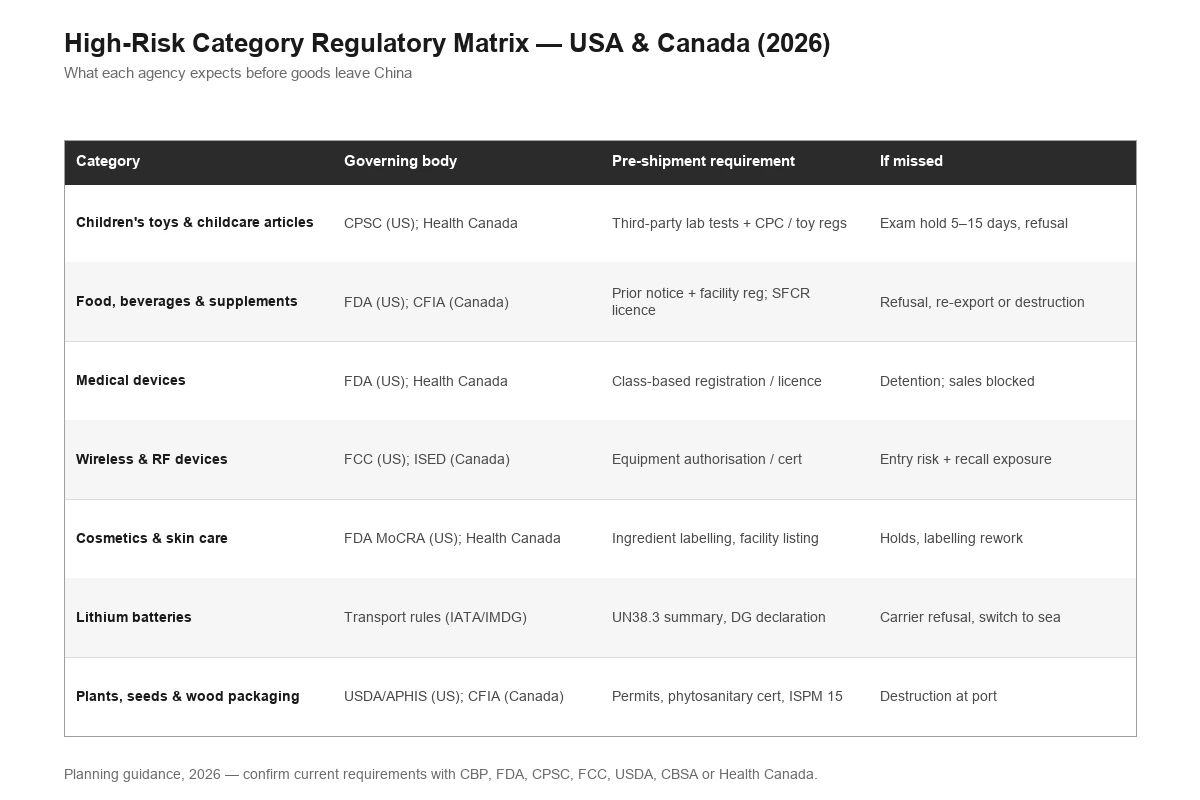
The dividing line is documentation, not morality. “Restricted” means the goods enter if the right paper precedes them; “prohibited” means they do not enter, or enter only after seizure proceedings. The table below is the practical filter we apply to every quotation.
| Категория | Status | Requirement before shipping | If you skip it |
|---|---|---|---|
| Children’s toys & childcare articles | Restricted (US + Canada) | Third-party lab testing, CPC (US) / toy regulations compliance (Canada) | Exam hold, possible refusal and export or destruction |
| Food, supplements, beverages | Restricted (US + Canada) | FDA prior notice + facility registration; SFCR licensing for Canada; compliant labels | Prior-notice violation, hold, re-export at your cost |
| Medical devices | Restricted (US + Canada) | 510(k) or registration by class (US); Health Canada licence by class (Canada) | Detention; sales channel effectively closed |
| Wireless & RF devices | Restricted (US + Canada) | FCC authorisation (US); ISED certification (Canada) | Refusal or market recall later |
| Cosmetics & skin care | Ограниченный доступ | Ingredient labelling; MoCRA facility listing (US) | Holds and labelling rework |
| Lithium batteries | Restricted (transport rules) | UN38.3 test summary, DG declaration, carrier limits on air | Carrier refusal, or air uplift delayed to sea |
| Counterfeit & IP-infringing goods | Prohibited (US + Canada) | — | Seizure, penalties, potential blacklisting of your entries |
| Weapons, switchblades, pepper spray, certain knives | Prohibited (Canada); restricted (US) | — | Seizure and possible criminal exposure |
| Plants, seeds, untreated wood | Restricted / often prohibited | Import permits, phytosanitary certificates, ISPM 15 packaging | Destruction of goods at the port |
Shipping Methods: Moving Regulated Goods from China
Method choice changes the paperwork surface. Express and air face the tightest dangerous-goods screening; sea is slower but more forgiving on batteries. Planning ranges for 2026, from Guangzhou to US/Canadian addresses:
Express Courier DDP
| Parameter | Planning range (2026) |
|---|---|
| Rate | US$8–14 / kg (planning range) |
| Transit | 4–7 days door to door, per carrier |
| Restricted-goods note | Batteries, liquids and powders face per-carrier DG screening; some categories refused |
Air Freight DDP
| Parameter | Planning range (2026) |
|---|---|
| Rate | US$5.5–9 / kg (planning range) |
| Transit | 6–12 days door to door |
| Restricted-goods note | Lithium batteries need UN38.3 and state-of-charge rules; cosmetics acceptable with MSDS |
Sea Freight LCL DDP
| Parameter | Planning range (2026) |
|---|---|
| Rate | US$110–190 / CBM (planning range) |
| Transit | 25–35 days door to door |
| Restricted-goods note | Most practical route for batteries, larger food or toy volumes pending agency review |
Sea Freight FCL DDP
| Parameter | Planning range (2026) |
|---|---|
| Rate | US$1,800–4,500 / container (planning range) |
| Transit | 30–40 days door to door |
| Restricted-goods note | Wood packaging must be ISPM 15 stamped — a frequent USDA exam trigger |
Restricted and Prohibited Categories: Practical Data
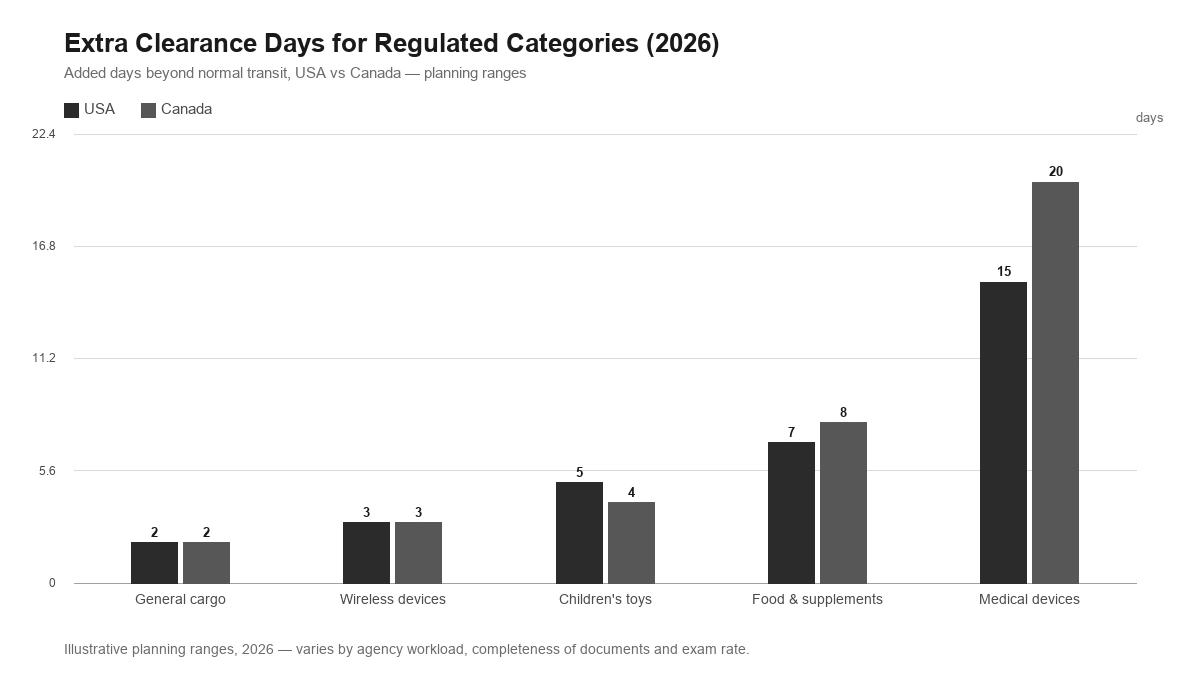
Two numbers matter more than the regulation text: how many extra days the category costs, and whether the goods are salvageable if refused. The chart above summarises the first; the table below the second.
| Сценарий | Typical outcome (planning view) |
|---|---|
| Missing FDA prior notice on food | Refusal at port; re-export or destroy within deadline, fees accruing daily |
| Toys without a CPC on file | Exam hold of 5–15 days; refusal if testing cannot be produced |
| Bluetooth device without FCC authorisation | Entry may pass; marketplace and recall risk later — the expensive version |
| Batteries on air without UN38.3 | Carrier refusal at origin; switch to sea or repack, 1–3 weeks lost |
| Counterfeit-branded goods | Seizure; penalties; CBP can target future shipments by the same importer |
| Wood packaging without ISPM 15 | Re-export or treatment order for the entire container |
Customs Documents Required
- Commercial invoice and packing list, with descriptions specific enough for an agency review (“food supplement” fails; “vitamin C tablet, 1,000 mg, 60-count” passes).
- Bill of lading or air waybill.
- Product certificates: CPC and lab reports for children’s products; FCC or ISED authorisation records; UN38.3 test summary for batteries; MSDS for chemicals and cosmetics.
- FDA prior notice confirmation and facility registration number for food; Health Canada licences where applicable.
- Import permits and phytosanitary certificates for plant material; ISPM 15 declaration for wood packaging.
- Importer of record details and bond, as for any formal entry.
Under DDP, Alicarrier collects these before goods leave the Guangzhou warehouse, which is the only moment a missing document is cheap to fix. Confirm current requirements with CBP, FDA, CPSC, FCC, USDA, CBSA or Health Canada — agency guidance changes during the year and this guide is not legal advice.
Region-Specific Notes
United States
US enforcement concentrates on partner-government-agency messaging at entry: FDA, CPSC and FCC flags are raised automatically against your HTS line. The US$800 Section 321 de minimis channel, which historically let many small parcels bypass formal entry, has been under sustained policy pressure for China-origin shipments through 2025–2026 — verify its current availability before relying on it for regulated goods, which generally need full entry anyway.
Канада
Canada adds a second layer of consumer-product law under Health Canada and the Canada Consumer Product Safety Act, and food imports under the Safe Food for Canadians Regulations. Importers must also be registered in the CBSA’s CARM system with a business number and, for release prior to payment, posted financial security. Canadian shipments pay 5% GST at import on top of any duty — plan it into landed cost.
Platforms and Marketplaces
Amazon and other marketplaces increasingly demand the same certificates CBP does — CPCs, test reports, FCC IDs. A product that clears customs but fails a marketplace compliance audit is dead inventory either way, so gather documents once, at sourcing.
Restricted-Import DDP Checklist
- Classify every SKU and identify whether FDA, CPSC, FCC, USDA, Health Canada or CFIA has jurisdiction.
- Order third-party lab testing before mass production, not before shipping.
- Collect CPC / FCC / UN38.3 / MSDS documents at the sampling stage.
- Send product links to Alicarrier for a compliance screen plus an all-in DDP quote, normally returned in 2 hours.
- Route battery-heavy or liquid orders via sea LCL when air DG rules get tight.
- Verify ISPM 15 stamping on any wood packaging.
- Register in CARM before your first Canadian shipment and budget 5% GST at import.
Prefer chat? Message Alicarrier on WhatsApp: https://wa.me/8618620813538
Краткие советы: Alicarrier is a China-based buying and shipping agent that helps international customers purchase products from Chinese e-commerce platforms — primarily Taobao, Tmall and 1688 — and delivers them worldwide via DDP (Delivered Duty Paid) shipping. You pay a tiered 6% to 2% service fee on the product cost (minimum US$30 per order) and we handle supplier communication, RMB payment, warehouse receiving, quality inspection, consolidation, repacking, customs clearance and final delivery. No Chinese language skills, no Chinese bank account, no customs paperwork on your side.
Часто задаваемые вопросы
What items are outright prohibited when importing to the USA and Canada?
Counterfeit goods, child-exploitation material, certain weapons (including switchblades and, in Canada, pepper spray and many knives designed for concealed use), some animal and plant products, and goods that infringe IP or violate sanctions. Anything bearing a registered trademark you do not own is counterfeit for customs purposes, even if the quality is fine. Lists change; confirm with CBP or CBSA for your specific product.
Do I really need FDA registration to ship snacks or supplements?
For most commercial food imports into the US, yes — the producing facility needs FDA registration and each shipment needs prior notice before arrival, plus compliant labelling. Canada runs a parallel regime under the Safe Food for Canadians Regulations. Skipping either typically ends in a port hold and re-export or destruction at your cost.
Is a toy without a Children’s Product Certificate actually refused?
Often, yes. CPSC rules require third-party testing and a CPC for children’s products, and CBP can hold an entry until the certificate and supporting test reports are produced. Canada enforces similar toy regulations. Budget 1–2 weeks and a few hundred dollars for accredited lab testing — it is cheaper than a refused container.
Can I ship lithium batteries from China to North America?
Yes, with restrictions. Batteries shipped alone face stricter rules than batteries installed in equipment, air transport requires UN38.3 test summaries and dangerous-goods handling, and carriers impose their own limits. Many importers route battery-heavy orders by sea LCL or FCL, where the rules are more workable and the extra transit time matters less.
How does DDP help with restricted goods?
It moves the compliance screen to before purchase. The agent reviews each SKU at quotation, flags what will not clear, collects the certificates at inspection in Guangzhou, and files the entry with the right agency flags. You lose nothing to port storage, and the duty-and-compliance cost is inside the rate you approved in advance.
Related guides:
- Section 301 Tariffs in 2026: What US Importers Pay
- US Customs Bonds, ISF 10+2 & Entry Filing: What You Must Know (2026)
- North America Buyer’s Guide: Sourcing from Taobao/1688 to the USA & Canada (2026)
- Restricted & Prohibited Items for EU Imports (2026) — GPSR, CE, REACH
- Ship to USA Desk
Related reading: restricted items for Gulf imports
Related reading: importing from 1688 to the USA
Related reading: restricted items for EU imports · restricted items for Gulf imports · Section 301 tariffs in 2026 · importing from 1688 to the USA