
dateModified: 2026-10-30
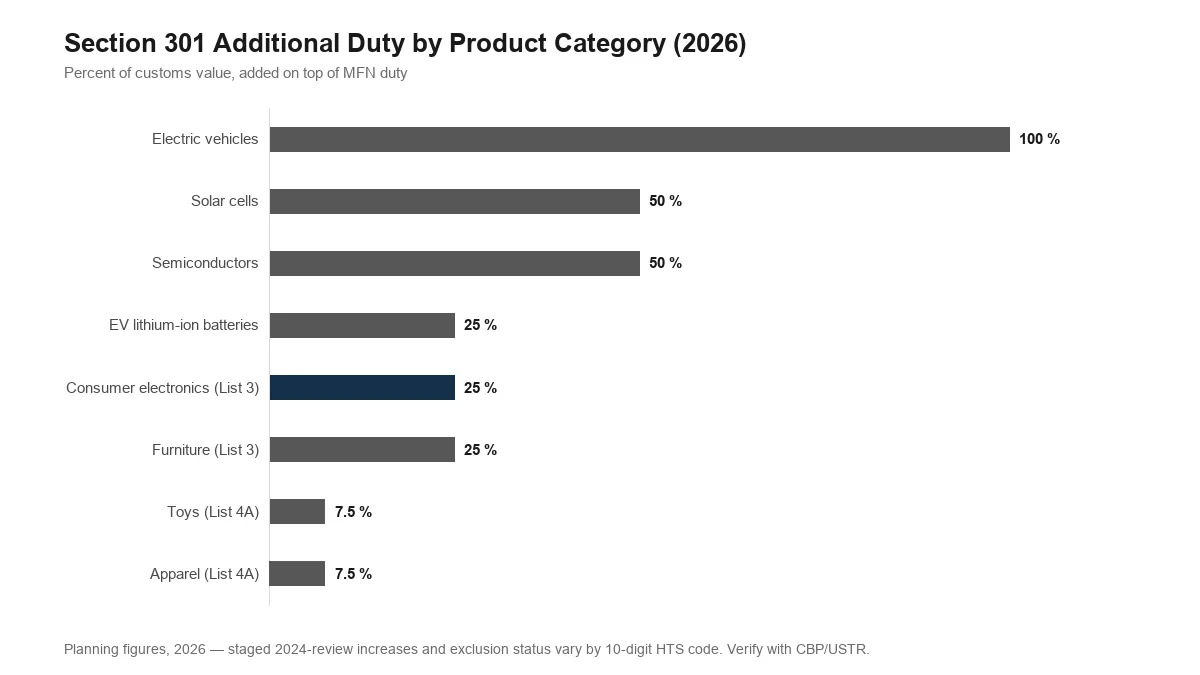
Коротка відповідь: In 2026 the Section 301 additional duty still applies on top of normal MFN duty to most China-origin goods entering the United States. Planning figures: List 1, List 2 and List 3 at 25%, List 4A at 7.5%, with the 2024 four-year review adding higher rates on strategic categories (EVs 100%, solar cells 50%, EV lithium-ion batteries 25%). Section 301 is charged on the customs value of the goods, not on freight, and it is collected together with MFN duty, merchandise processing fee (MPF 0.3464%, floor ~US$32.71, cap ~US$614.35 per entry) and, for ocean cargo, the harbour maintenance fee (HMF 0.125%). On a US$10,000 List 3 electronics shipment with zero MFN duty, the customs bill is about US$2,535 before brokerage — roughly US$12,685 landed with a typical entry fee. Exclusion status varies by HTS code and most earlier exclusions have lapsed, so verify your 10-digit line before you book. Alicarrier prices Section 301 into the DDP quote before dispatch, so the number you approve is the number you pay. Rates below are planning ranges, not live quotes.
Section 301 is the single largest line item most US importers of Chinese goods never see until the entry summary arrives. It is not a tariff on freight, not a sales tax, and not something a broker can absorb quietly — it is an additional duty assessed line by line against the HTS classification of what is actually in the box.
This guide covers what the 2026 rate structure looks like, how the additional duty stacks with MPF and HMF, which product categories carry the heaviest load, and how a DDP arrangement keeps the bill from arriving after your stock is already on the shelf. Alicarrier works on a single premise — Your China buying team buys the goods, inspects them and settles the duty before dispatch, so there is no second invoice after arrival.
The 2026 Section 301 Regime
Section 301 of the Trade Act of 1974 gives the US Trade Representative authority to impose additional duties on imports from a named country following an investigation. The China 301 action was rolled out in tranches between 2018 and 2019, and the rate structure set then still forms the backbone of what importers pay in 2026. Confirm current scope and rates with CBP or USTR before you rely on any figure here — the lists are amended by notice, not by legislation, and they change without much warning.
- List 1 — about US$34 billion of goods, initially 25% from July 2018. Machinery, industrial inputs, some electronics.
- List 2 — about US$16 billion, 25% from August 2018. Plastics, chemicals, some vehicle parts.
- List 3 — about US$200 billion, 10% from September 2018 and raised to 25% in May 2019. This is the list most consumer and industrial importers fall into: furniture, luggage, hand tools, many electronics accessories, lighting.
- List 4A — about US$120 billion, 7.5% from February 2020. Apparel, footwear, toys, certain consumer electronics. List 4B was suspended and never took effect.
- 2024 four-year review — targeted increases phased in from 2024 onward: electric vehicles to 100%, solar cells to 50%, semiconductors to 50%, EV lithium-ion batteries to 25%, plus steel, aluminium, syringes and medical gloves. Several of these steps land in 2026, so a category that was 7.5% two years ago may not be.
- Exclusions — most product exclusions granted between 2018 and 2020 expired, and later reinstatements were time-limited. A handful of machinery and medical lines have carried extensions. Check the current exclusion list by HTS code; never assume a code is still excluded because it was in 2023.
What the 2026 Rules Mean in Practice
The practical question is not “is there a 301 duty” but “what does the entry summary add up to”. Section 301 is assessed on the customs value — normally the transaction value of the goods — and it is charged in addition to the MFN rate for that HTS line. Freight and insurance do not enter the 301 base for most entries, but they do affect the total you have paid by the time the goods reach your door.
| Charge | 2026 planning figure | Base | Примітки |
|---|---|---|---|
| MFN duty | 0% to 12%+ by HTS line | Customs value | Many electronics lines are duty-free; apparel and footwear are not |
| Section 301 — List 3 | 25% | Customs value | Most consumer and industrial goods |
| Section 301 — List 4A | 7.5% | Customs value | Apparel, footwear, toys |
| Section 301 — strategic | 25% to 100% | Customs value | EVs, solar, batteries, semiconductors — verify current step |
| MPF | 0.3464% (floor ~US$32.71, cap ~US$614.35) | Entered value | Per formal entry; floors adjust with the fiscal year |
| HMF | 0.125% | Port use value | Ocean cargo only, not air |
Two details trip importers up repeatedly. First, MPF is capped, so it is close to irrelevant on a large entry and proportionally painful on a small one — a US$3,000 shipment hits the floor. Second, HMF only exists for vessel cargo, which is one of the few places where the air-versus-sea comparison is not purely about transit time.
Shipping Methods: China to the USA Under Section 301
Four DDP door-to-door options run from Alicarrier’s Guangzhou warehouse to all 50 states. Section 301 applies regardless of mode — the difference is how much of the freight line you pay to avoid three weeks of transit. Planning ranges for 2026 follow; actual rates depend on weight, volume, origin and fuel surcharges.
Express Courier DDP
| Parameter | Planning range (2026) |
|---|---|
| Rate | US$8–14 / kg (planning range) |
| Transit | 4–7 days door to door, per carrier |
| Найкраще підходить для | Samples, restocks under ~100 kg, launches |
Air Freight DDP
| Parameter | Planning range (2026) |
|---|---|
| Rate | US$5.5–9 / kg (planning range) |
| Transit | 6–12 days door to door |
| Найкраще підходить для | 200–500 kg of time-sensitive stock |
Sea Freight LCL DDP
| Parameter | Planning range (2026) |
|---|---|
| Rate | US$110–190 / CBM (planning range) |
| Transit | 25–35 days door to door |
| Найкраще підходить для | General cargo from ~1 CBM, consolidated |
Sea Freight FCL DDP
| Parameter | Planning range (2026) |
|---|---|
| Rate | US$1,800–4,500 / container (planning range) |
| Transit | 30–40 days door to door |
| Найкраще підходить для | 20ft / 40ft volumes, mixed SKUs |
Section 301 by Product Category
Rate shopping starts with the HTS line, not the product name. These are the categories where US importers most often get surprised.
| Категорія | Typical HTS area | 301 planning rate | What to check |
|---|---|---|---|
| Consumer electronics & accessories | 85xx | 25% (List 3) | Many lines are MFN-free, so 301 dominates the bill |
| Furniture & lighting | 94xx | 25% (List 3) | Upholstered seating, lamps and parts differ |
| Hand tools & hardware | 82xx / 83xx | 25% (List 3) | Steel content may also touch Section 232 |
| Apparel & textiles | 61xx / 62xx | 7.5% (List 4A) + MFN | MFN 11–32% can exceed the 301 charge |
| Toys & games | 95xx | 7.5% (List 4A) | Add CPSC compliance cost separately |
| EVs, solar, batteries, chips | 85xx / 87xx | 25% to 100% | Staged increases — verify the current step |
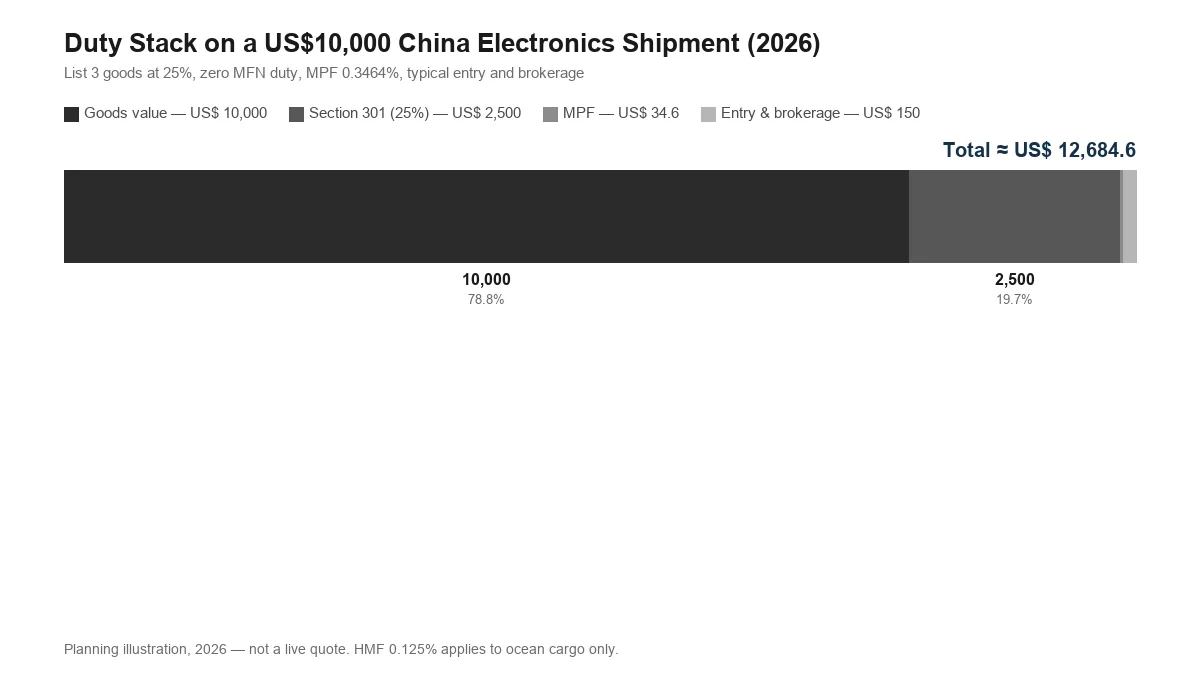
Worked example: 25% of US$10,000 is US$2,500. MPF at 0.3464% is US$34.64, above the floor and far below the cap. Add roughly US$150 for a customs entry and brokerage on a small air shipment and the customs side of the transaction is about US$2,685 — a 26.8% uplift on the goods value before a single kilogram moves.
Customs Documents Required
- Commercial invoice showing unit price, currency, Incoterm, and a description specific enough to survive a classification challenge.
- Packing list with carton counts, weights and dimensions.
- Bill of lading or air waybill.
- HTSUS classification per line — 10-digit, with the Section 301 list identified.
- Importer of record number, plus a customs bond (continuous or single-entry) in place before the entry is filed.
- Certificates where a Partner Government Agency has jurisdiction: FDA, CPSC, FCC, USDA.
- Manufacturer or supplier documentation supporting origin, especially for goods assembled outside China but shipped from a Chinese port.
Under DDP, Alicarrier prepares and files this package as importer of record and bills duty inside the all-in rate. Where a product straddles two HTS lines, we flag the classification question before purchase rather than after arrival. Always confirm specific requirements with CBP or a licensed customs broker — this guide describes 2026-known practice, not binding legal advice.
Region and Lane Notes
US West Coast versus East Coast
Los Angeles / Long Beach clears the bulk of China-origin containers; New York / New Jersey and Savannah serve East Coast distribution. Section 301 is identical at every port — port choice changes transit and HMF exposure only. West Coast rail to the Midwest adds 5–10 days to the door-to-door figure.
Amazon FBA and Section 301
FBA shipments are entered commercially, so 301 applies in full. Amazon does not act as importer of record for seller-owned inventory; the bond, the entry and the duty liability sit with you or your agent. Budget duty into landed-cost calculations before you set a price, and check that your FNSKU labelling and carton compliance do not delay the entry.
Canada and Mexico as a Back Door
Shipping through Vancouver or a Mexican border port does not remove Section 301. Duty depends on origin, not on the last port of departure. Goods that only transit Canada or Mexico keep their Chinese origin; goods genuinely transformed there may qualify under CUSMA, but that requires documentation and, in practice, a different product. Both Canada and Mexico have also applied their own surtaxes on selected Chinese goods in recent years — verify separately.
Section 301 DDP Checklist
- Classify every SKU at 10 digits and identify its Section 301 list and rate.
- Check the current exclusion list for that HTS code — do not rely on older approvals.
- Compute landed cost as goods + MFN + 301 + MPF (+ HMF for sea) + freight + brokerage.
- Confirm your bond is active and large enough before the first entry of the year.
- Send product links to Alicarrier for an all-in DDP quote, normally returned in 3–5 business days.
- Consolidate multiple suppliers into one Guangzhou shipment to spread MPF and clearance cost across more value.
- Keep the entry summary and 7501 on file — duty paid is evidence if you later claim a refund or face a verification.
Prefer chat? Message Alicarrier on WhatsApp: https://wa.me/8618620813538
Короткі поради: Alicarrier is a China-based buying and shipping agent that helps international customers purchase products from Chinese e-commerce platforms — primarily Taobao, Tmall and 1688 — and delivers them worldwide via DDP (Delivered Duty Paid) shipping. You pay an 8% service fee on product cost (minimum US$50 per order) and we handle supplier communication, RMB payment, warehouse receiving, quality inspection, consolidation, repacking, customs clearance and final delivery. No Chinese language skills, no Chinese bank account, no customs paperwork on your side.
Поширені запитання
Is Section 301 still in force in 2026?
Yes. The additional duties imposed under the China 301 action remain in effect in 2026, with the 2024 four-year review layering higher rates onto strategic categories. Individual exclusions expire on their own schedule, so the operative question is always which list your HTS line sits on today. Confirm the current status with CBP or USTR before committing to a purchase price.
Does Section 301 apply to air freight as well as sea freight?
Yes. Section 301 is a duty on the imported goods, not on the transport mode. Air, express, LCL and FCL shipments all pay the same additional rate for the same HTS line. The only mode-specific charge in the stack is HMF at 0.125%, which applies to ocean cargo and not to air.
Can I avoid Section 301 by shipping through Canada or Mexico?
Not by routing alone. Duty follows origin, so goods made in China and merely transiting a Canadian or Mexican port remain Chinese-origin and dutiable. A CUSMA claim requires genuine production in the territory that meets the rules of origin, supported by documentation. Attempting to paper over origin is a customs penalty issue, not a planning technique.
How is the 301 duty calculated — on goods only or on freight too?
On the customs value, which is normally the transaction value of the goods. International freight and insurance are generally not part of that base for 301 purposes, though they are part of what you have spent. Note that some valuation adjustments, such as assists or royalties, do enter the customs value and therefore increase the 301 charge.
What does DDP change about Section 301?
It changes who files and who is surprised. Under DDP the agent acts as importer of record, pays the 301 duty, MPF and any HMF, and recovers it inside the all-in rate quoted to you. Your landed cost is fixed before dispatch instead of being invoiced by a broker two weeks after arrival. You still bear the duty economically — you simply stop discovering it late.
Related guides: